






What's Happening?
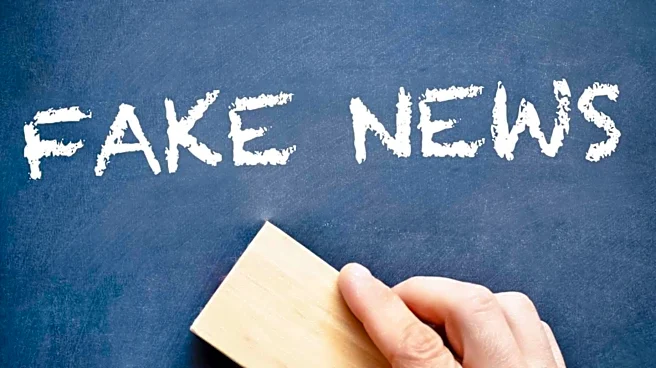
Misinformation is significantly weakening the relationship between society and science, according to insights from Polytechnique Insights. Factors such as foreign interference, declining information quality, economic difficulties, and health scandals
are destabilizing public trust in institutions and, consequently, in scientists. While overall trust in science remains relatively high and stable, specific scientific findings, like the anthropogenic origin of climate change, are being challenged by a segment of the population due to conspiracy theories. The issue of misinformation is not merely individual but deeply rooted in structural contexts. During the COVID-19 pandemic, collaboration between scientific institutions and political leaders faced heightened public distrust, fueled by anti-vaccine and anti-lockdown movements. This distrust extends to various political subjects, including climate science, leading to an increased rejection of scientific institutions.
Why It's Important?
The erosion of trust in scientific institutions has profound implications for public policy and societal well-being in the U.S. When scientific consensus on critical issues like climate change or public health is undermined, it can hinder effective policy-making and collective action. Industries reliant on scientific advancements, such as healthcare and renewable energy, may face public skepticism and resistance, potentially slowing innovation and adoption. The politicization of scientific questions means that expert opinions are often evaluated through partisan lenses, making it challenging to address complex societal problems based on evidence. This environment benefits actors who intentionally propagate false information to obstruct action on issues like climate change, creating a polarized society where social and economic grievances can make individuals more susceptible to misinformation. Ultimately, this dynamic can lead to a less informed public and a weakened capacity for the nation to respond to challenges requiring scientific understanding and consensus.
What's Next?
Addressing the vulnerabilities that allow misinformation to thrive is a crucial next step. This involves understanding how individuals process information and adjust their vigilance based on its relevance and impact on their daily lives. While people are not passive recipients of information, their interest in verifying its veracity varies, and often, believing false information has little immediate consequence for them. Future efforts will likely focus on strengthening the public's epistemic vigilance, which involves evaluating both the plausibility of content against prior knowledge and the perceived competence and sincerity of the source. This approach acknowledges that emotional and social motivations often outweigh the desire for truth, suggesting that strategies to combat misinformation must go beyond simply presenting facts. Cultivating less polarized public discourse and demonstrating that institutions, both scientific and political, are aligned with public interests will be essential to rebuilding trust.
Beyond the Headlines
The deeper implications of pervasive misinformation extend to the very fabric of democratic society and individual autonomy. The source highlights that conspiracy theories often tap into emotions like fear, sadness, or anger, influencing the quality of reasoning. Personal traits, educational background, gender, and socioeconomic precarity can also affect an individual's susceptibility to false information. This suggests that misinformation is not merely an intellectual problem but a complex socio-emotional phenomenon. The observation that individuals might maintain false beliefs for social benefits, such as making friends, underscores the powerful social dimensions of belief formation. This points to a long-term shift where social suffering, economic hardship, and societal polarization are significant drivers of susceptibility to misinformation, rather than just ignorance. Rebuilding trust requires not only factual correction but also addressing underlying social and emotional needs, fostering environments where open, less polarized debates can occur, and ensuring institutions genuinely serve the public good.