



What's Happening?
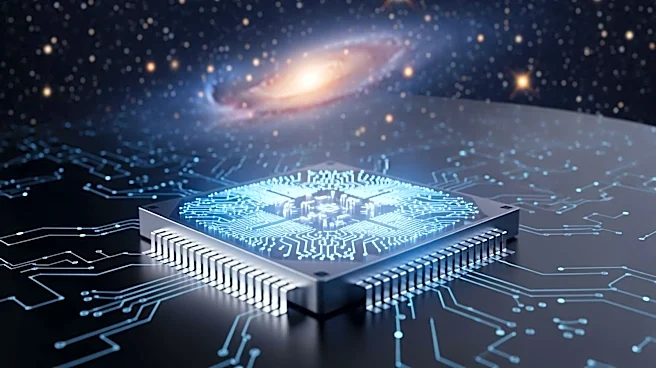
NASA is advancing its space exploration capabilities with the development of a new AI-powered computer chip designed to significantly enhance the intelligence and performance of future spacecraft. This initiative, part of NASA's High Performance Spaceflight
Computing project, aims to create a processor that can operate independently during missions far from Earth. The new chip, developed in collaboration with Microchip Technology Inc., is expected to deliver up to 100 times the computing power of current spaceflight computers. It is designed to withstand the harsh conditions of space, including intense electromagnetic radiation and temperature fluctuations. Testing of the chip, which began in February at NASA's Jet Propulsion Laboratory, has shown promising results, with performance levels reportedly 500 times greater than existing radiation-hardened chips.
Why It's Important?
The development of this advanced processor is crucial for the future of space exploration, particularly for missions to the Moon and Mars. The chip's enhanced computing power and autonomy will allow spacecraft to perform complex tasks and respond to unexpected situations without relying on real-time human intervention, which is often impractical due to communication delays. This capability is essential for deep space missions, where quick decision-making is critical. Additionally, the processor's ability to process and transmit large volumes of scientific data efficiently will enhance the scientific return of these missions. The collaboration between NASA and Microchip Technology Inc. also highlights the importance of public-private partnerships in advancing space technology.
What's Next?
As testing continues, NASA plans to integrate the new processor into a variety of missions, including Earth orbiters, planetary rovers, and deep space probes. The chip is also expected to support crewed missions to the Moon and Mars, providing critical computing power for onboard systems. Once certified for space use, the processor could revolutionize how spacecraft operate, making them more autonomous and capable of handling complex tasks independently. The technology may also have terrestrial applications, with potential benefits for industries such as aviation and automotive manufacturing.