




What's Happening?
James Allen, the Elections Director for Delaware County, Pennsylvania, recently addressed concerns regarding election security and procedures. During a 'Hot Topic' seminar hosted by the League of Women Voters of Central Delaware County, Allen detailed
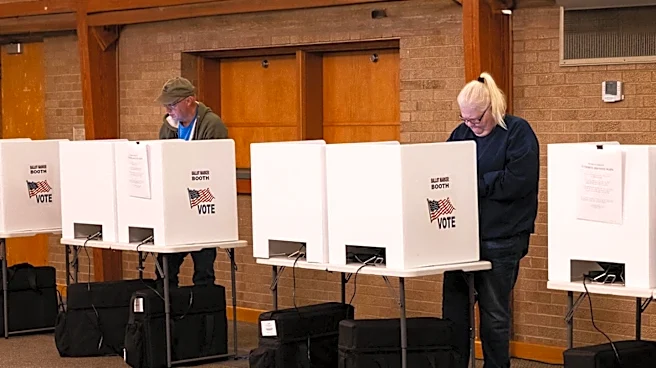
the processes involved in county elections, including mail-in voting, chain of custody protocols, and dispelling concerns about non-citizens voting. He discussed the U.S. Supreme Court's decision to decline the U.S. Postal Service's involvement in certain new provisions, citing the 'Purcell principle' against last-minute changes to election systems. Allen affirmed the county's readiness to comply with any mandates and highlighted the robust security measures in place, such as 100% chain of custody for ballots and V-drives, and the training of poll workers in de-escalation techniques. He also clarified that assertions about non-citizens registering to vote are largely false, with rare instances typically being clerical errors.
Why It's Important?
The detailed explanation by Delaware County Elections Director James Allen is crucial for reinforcing public confidence in the integrity of the U.S. electoral system, particularly in a period marked by heightened scrutiny and misinformation. His emphasis on established procedures, such as the chain of custody for ballots and V-drives, directly addresses common concerns about election tampering and fraud. By clarifying the Supreme Court's stance on election changes and the rarity of issues like non-citizen voting, Allen helps to counter narratives that could undermine democratic processes. This transparency is vital for ensuring that voters feel secure in their participation and trust the outcomes of elections. The training of poll workers in de-escalation also highlights efforts to protect voters from intimidation, ensuring that the fundamental First Amendment right to vote is upheld without fear.
What's Next?
Following Director Allen's comprehensive overview, Delaware County residents can expect continued efforts to maintain and communicate election security protocols. The focus will likely remain on encouraging early mail-in ballot applications and returns via county drop boxes, as emphasized by Allen. The upcoming election will serve as a practical test of the procedures and training discussed, with poll workers prepared to handle any incidents and report them to election officials for immediate action. The elections hotline will continue to be a resource for voters with questions or to report issues. Furthermore, the ongoing legislative initiative by state Sen. Tim Kearney to limit corporate money in Pennsylvania elections, though separate from Allen's presentation, indicates a broader movement to address influences on the electoral process, suggesting that discussions around election integrity and fairness will persist at multiple levels.
Beyond the Headlines
Beyond the immediate operational aspects of election security, Director Allen's presentation touches upon deeper societal implications regarding trust in democratic institutions. The need for such detailed explanations underscores a broader challenge in the U.S. to combat misinformation and rebuild public confidence in electoral processes. The emphasis on evidence-based systems, rather than 'trust' in a personal sense, reflects a scientific approach to election administration, aiming to depoliticize the technical aspects of voting. This approach is critical in an era where election outcomes are frequently questioned. The discussion also implicitly highlights the importance of civic education and the role of organizations like the League of Women Voters in informing the public. Ultimately, the efforts in Delaware County contribute to a national dialogue about safeguarding democracy, ensuring that the mechanisms of voting are not only secure but also perceived as such by the electorate.