




What's Happening?
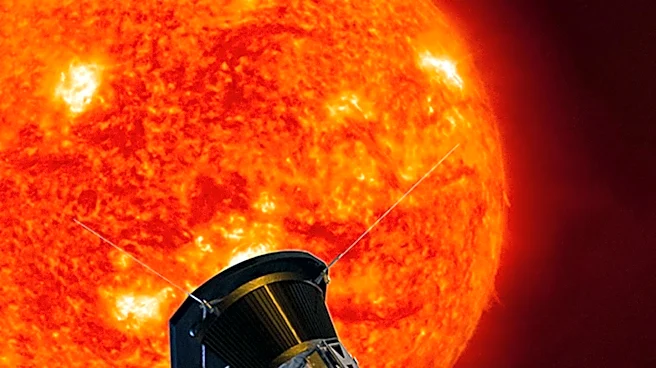
NASA's Parker Solar Probe, launched in 2018, has achieved a historic milestone by flying closer to the Sun than any human-made object in history. On December 24, 2024, the probe passed within 3.8 million miles of the Sun's surface, traveling at a speed
of 430,000 miles per hour. This mission aims to study the Sun's corona, a region with temperatures exceeding one million degrees Fahrenheit, which had previously only been observed from a distance. The probe's instruments, protected by a sophisticated heat shield, have provided unprecedented in-situ measurements of solar phenomena, including the 'switchback' magnetic field reversals in the solar wind. These findings are crucial for understanding the acceleration of solar wind and the Sun's magnetic field structures.
Why It's Important?
The Parker Solar Probe's mission is significant for advancing our understanding of solar physics, particularly the mechanisms behind solar wind acceleration. This knowledge is vital for predicting space weather, which can impact satellite operations, communication systems, and power grids on Earth. By providing direct measurements of the Sun's outer atmosphere, the probe helps scientists develop better models of solar activity, potentially leading to improved forecasting of solar storms. The mission's success also demonstrates the capabilities of advanced engineering solutions, such as the heat shield, which allows the probe to withstand extreme temperatures and gather critical data.
What's Next?
The Parker Solar Probe is scheduled to continue its mission until at least 2026, with further close approaches to the Sun planned. As the probe's propellant reserves deplete, it will eventually be unable to maintain its heat shield orientation, leading to its destruction by the Sun. Until then, the probe will continue to provide valuable data, enhancing our understanding of solar dynamics and contributing to the development of more accurate space weather prediction models.