
What's Happening?
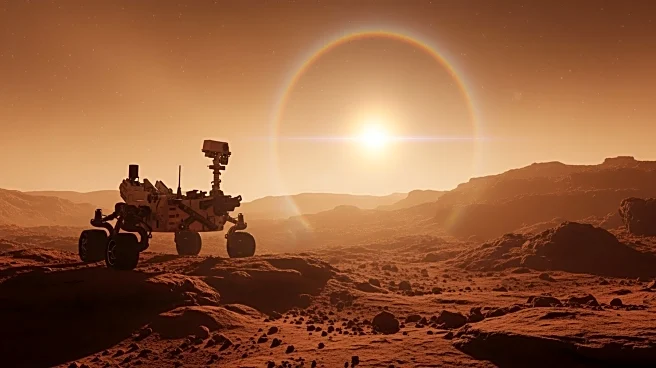
NASA's latest report, prepared by the National Academies, emphasizes that future Mars missions should prioritize the search for signs of life as their main scientific goal. The report outlines 11 key scientific objectives
for human exploration of Mars, with the highest priority being the search for life, understanding pre-life chemical processes, and evaluating the planet's overall habitability. NASA aims to send astronauts to Mars by the mid-2030s, and the report suggests establishing a scientific laboratory on Mars, bringing samples back to Earth, and coordinating efforts between astronauts, robotic missions, and artificial intelligence. The report also highlights the importance of studying Mars' water and carbon dioxide cycles, mapping its topography, and understanding the effects of Martian conditions on DNA, fertility, and microorganisms.
Why It's Important?
The report's emphasis on searching for life on Mars has significant implications for scientific research and exploration strategies. By prioritizing the search for life, NASA can potentially uncover groundbreaking discoveries about the existence of life beyond Earth, which could have profound impacts on our understanding of biology and the universe. Additionally, the focus on habitability and pre-life chemistry could inform future efforts to establish sustainable human settlements on Mars. The coordination between astronauts, robotic missions, and artificial intelligence could enhance the efficiency and effectiveness of Mars exploration, potentially leading to more comprehensive scientific outcomes. The report also underscores the need for international collaboration and adherence to planetary protection regulations, which are crucial for ensuring the safety and integrity of both Mars and Earth.
What's Next?
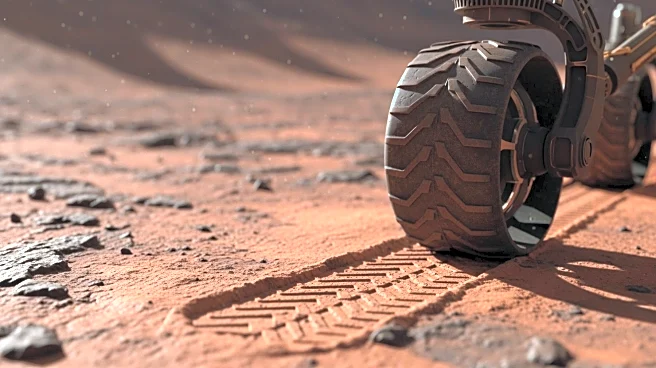
NASA is expected to continue developing its Mars exploration plans in line with the report's recommendations. This includes preparing for the establishment of a scientific laboratory on Mars and organizing a 'Mars Human-Agent Teaming Summit' to improve coordination between various mission components. The agency will likely work on refining its strategies for sample collection and return, as well as addressing the challenges posed by Martian dust and radiation. Additionally, NASA may engage with other international space agencies to update planetary protection regulations, ensuring safe and effective exploration of areas where life may exist. As the mid-2030s target for sending astronauts to Mars approaches, NASA will need to finalize mission plans and secure necessary funding and partnerships.
Beyond the Headlines
The report's focus on life search and habitability raises ethical and legal considerations regarding planetary protection and contamination. Ensuring that Mars remains uncontaminated by Earth's microorganisms is crucial for preserving its natural state and preventing interference with potential Martian life forms. The report suggests that NASA should collaborate with other agencies to update regulations, balancing scientific exploration with ethical responsibilities. Furthermore, the emphasis on artificial intelligence and robotic missions highlights the growing role of technology in space exploration, which could lead to advancements in AI and robotics that benefit other industries. The long-term implications of successful Mars missions could include shifts in public interest and investment in space exploration, potentially driving innovation and economic growth.