


What's Happening?
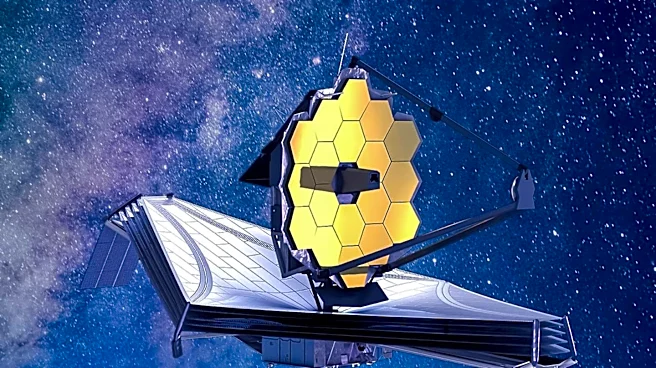
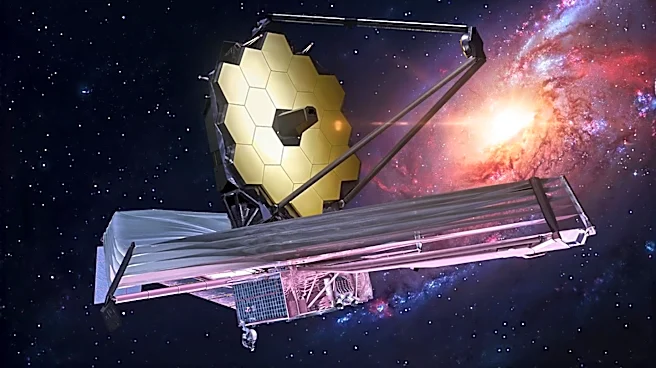
Observations from the James Webb Space Telescope (JWST) have revealed the presence of magnesium-rich phyllosilicates, a type of clay mineral, on two of Neptune's tiny inner moons, Larissa and Galatea, as well as in its rings. These moons are only about
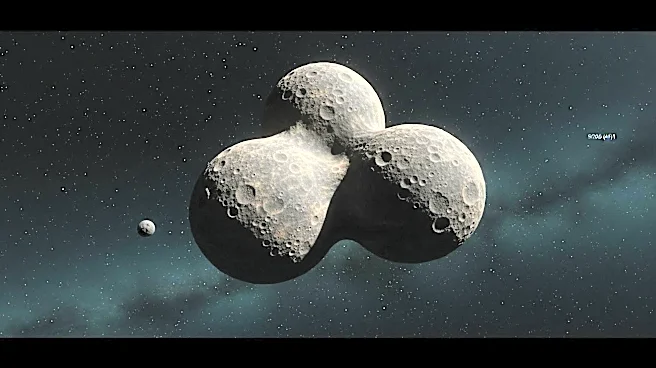
200 kilometers across and orbit in extremely cold conditions (around 50 Kelvin). Clay minerals typically form when liquid water alters silicate rock over extended periods at moderate temperatures, conditions that could not have existed on these small, cold bodies. This suggests that Larissa and Galatea are not primordial worlds but rather reassembled from the exposed interiors of much larger, shattered satellites. The evidence comes from near-infrared spectra, which show a deep absorption near three micrometers indicating hydroxyl bonds, and a sharp feature at 2.72 micrometers consistent with magnesium-rich phyllosilicates. Proteus, another inner moon observed, showed the broad hydrated signature but lacked the strong clay feature.
Why It's Important?
This discovery provides crucial insights into the violent and dynamic history of the Neptune system. It supports the leading hypothesis that Neptune's current inner moons and rings are remnants of a catastrophic event, likely the capture of Triton, Neptune's largest moon. Triton's retrograde orbit would have disrupted Neptune's original satellite system, leading to collisions and the destruction of larger, differentiated moons that once contained liquid water in their interiors. The presence of clay minerals acts as a 'material anchor' for these orbital reconstructions, offering tangible evidence of past aqueous alteration within these now-destroyed bodies. This helps scientists understand how planetary systems evolve, how moons form and are reformed, and the conditions under which water-rock interactions can occur in the outer solar system, even if those conditions no longer exist.
What's Next?
Further research is needed to refine the understanding of Neptune's satellite system history. This includes conducting laboratory measurements of candidate minerals at outer Solar System temperatures to better match the observed spectra. Scientists also plan to obtain spectra of additional moons and rings within the Neptune system. Advanced simulations will be crucial to test how rubble sorts itself and reaccretes after catastrophic collisions. The unidentified broad three-micrometer absorber, present on Proteus, Larissa, Galatea, and the rings, requires further investigation to determine its precise mineral carrier. Ultimately, future missions to Neptune, potentially including orbiters, would be invaluable to map these small moons, measure their masses and gravity fields, and examine surface variations, providing direct observations to complement the Webb telescope's spectral data.
Beyond the Headlines
The finding challenges the perception of small, icy moons as geologically inert bodies, revealing that they can carry a complex history embedded in their composition. It underscores that the current state of a planetary system might be a mere snapshot of a much more dramatic and transformative past. This discovery also highlights the power of advanced telescopic observations, like those from the JWST, to uncover detailed geological and chemical information from distant celestial bodies, pushing the boundaries of our understanding of planetary formation and evolution. The idea that the smallest moons are products of a larger loss adds a poetic dimension to our cosmic understanding, suggesting that even seemingly insignificant objects can hold profound secrets about the universe's grand narratives.