
What's Happening?
A recent experiment conducted by physicist Enbang Li at the University of Wollongong in Australia challenges the long-held assumption that the speed of light is constant, as postulated by Albert Einstein
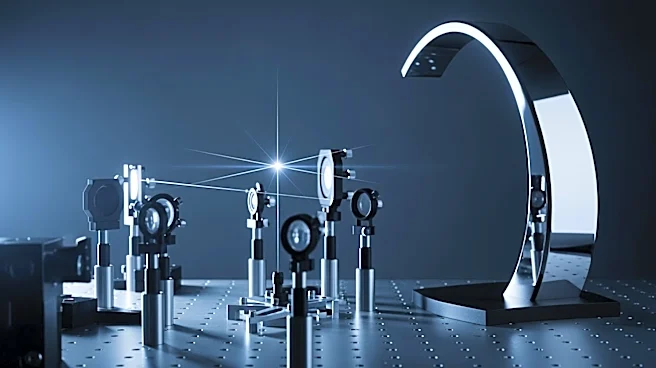
in his 1905 theory of special relativity. Li's experiment suggests that gravity can influence the speed of light, a concept Einstein himself considered in 1911 but later abandoned. The experiment involved using a coil of fiber-optic cable in an elevator shaft to measure the speed of light at different altitudes. The findings indicated that light moved faster at the bottom of the shaft compared to the top, suggesting that gravity affects light speed. Li further developed a portable machine to detect changes in light speed near gravitationally dense objects, with results supporting the variable speed of light model. These findings, if validated, could have significant implications for our understanding of general and special relativity.
Why It's Important?
The implications of Li's findings are profound, potentially challenging the foundational principles of physics established by Einstein. If gravity can indeed alter the speed of light, it could revolutionize gravity-sensing technologies used in Earth sciences. Such advancements could enhance the mapping of the seafloor, locating underground mineral reserves, and understanding Earth's climate through gravity field variations. Current gravimeters are sensitive to vibrations, but Li's machine, which lacks moving parts, could be used in dynamic environments like planes or submarines. This research pushes the boundaries of precision photonic measurement techniques, potentially making relativistic effects practically useful for geophysics and sensing applications. However, the results must be approached with caution, as the observable effects of gravity on light on Earth are expected to be extraordinarily small.
What's Next?
The next steps involve further validation of Li's findings through additional experiments and peer review. The scientific community will likely scrutinize the results to determine their accuracy and potential impact on existing theories. If proven, these findings could lead to the development of new technologies and methodologies in Earth sciences and beyond. Researchers may explore the practical applications of these results in various fields, including climate monitoring and resource exploration. The challenge lies in separating genuine gravitational signatures from environmental and instrumental noise, a task that requires precise measurement techniques. The broader scientific community will need to assess the implications of these findings on the current understanding of relativity and the fundamental laws of physics.
Beyond the Headlines
Li's research opens up new avenues for exploring the relationship between light and gravity, two of the most enigmatic aspects of physics. The potential for gravity to influence light speed could lead to a reevaluation of how we understand space-time and the universe's structure. This development may also prompt discussions on the ethical and philosophical implications of altering fundamental scientific principles. As the scientific community delves deeper into these findings, there may be a shift in how we approach and interpret the laws governing the universe. The research highlights the ongoing quest to unravel the mysteries of gravity and light, underscoring the dynamic nature of scientific inquiry and discovery.