
What's Happening?
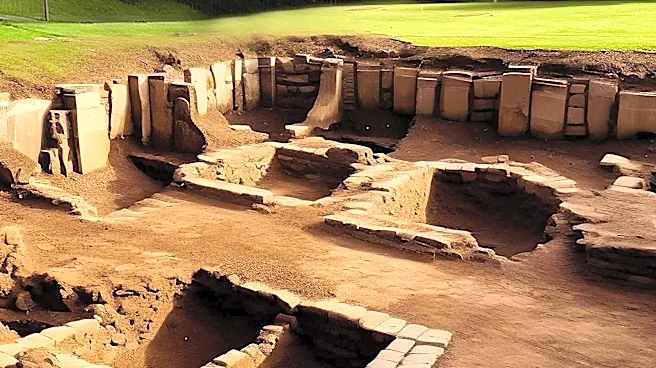
Archaeologists in Egypt have discovered an ancient tomb at Saqqara belonging to an official named Sekhentio-Ptah, who held the title of 'keeper of the secrets of royal decrees.' The tomb dates back to the Old
Kingdom (2649 to 2150 B.C.), a period renowned for pyramid construction. Sekhentio-Ptah also held other significant titles, including 'Overseer of all the King's Works' and 'Overseer of Royal Documents.' The excavation revealed an offering table, a purification basin, and two false doors, which Egyptologist Ann Macy Roth suggests date the tomb to the late fifth or early sixth dynasty, approximately 4,350 years ago. Over 100 shabti figurines, a wooden falcon statue, and cartonnage remains were also found, though Sekhentio-Ptah's mummy was not identified. The tomb was discovered in the Bubasteion area, known for later cat burials.
Why It's Important?
This discovery provides valuable insights into the administrative structure and burial practices of ancient Egypt during the Old Kingdom, a foundational period in Egyptian history. The titles held by Sekhentio-Ptah, particularly 'keeper of the secrets of royal decrees,' shed light on the bureaucratic roles within the royal court and the importance of record-keeping and confidential information. For Egyptology and historical studies, such findings contribute to a more complete understanding of societal organization, religious beliefs, and daily life in ancient civilizations. The presence of shabtis and false doors reinforces established knowledge about Egyptian beliefs in the afterlife and the rituals associated with it. The potential reuse of the tomb for later burials also offers clues about evolving burial customs and the long-term utilization of sacred sites.
What's Next?
Archaeological teams will likely continue to meticulously analyze the artifacts and the tomb's structure to gather more detailed information. Further research will focus on deciphering any hieroglyphic inscriptions, studying the style and materials of the discovered items, and potentially conducting carbon dating to confirm the precise age of various elements within the tomb. Experts will also aim to determine if Sekhentio-Ptah's mummy can be located or if the tomb was indeed reused for subsequent burials, as suggested by some findings. The findings will be documented, cataloged, and eventually published in academic journals, contributing to the global body of knowledge on ancient Egypt. Public exhibitions of some artifacts may also follow, allowing broader access to this historical discovery.
Beyond the Headlines
The unearthing of Sekhentio-Ptah's tomb transcends a mere archaeological find; it offers a tangible connection to the intricate lives of individuals who shaped one of the world's earliest great civilizations. The title 'keeper of the secrets' evokes a sense of intrigue, highlighting the enduring human fascination with power, information, and the mysteries of ancient courts. This discovery also underscores the continuous efforts to preserve and understand cultural heritage, reminding us of the vast amount of history still buried beneath the sands. Ethically, the careful excavation and preservation of such sites are paramount to respecting the past and ensuring that future generations can learn from these invaluable historical records. The ongoing discoveries at Saqqara continue to reveal the richness and complexity of ancient Egyptian society, challenging and refining our understanding of its enduring legacy.