



What's Happening?
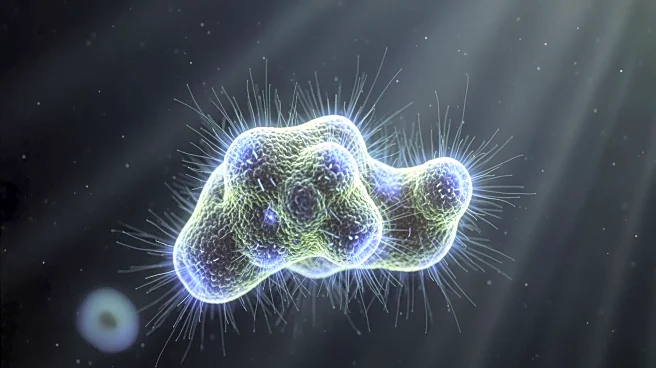
Researchers from Canada and Japan have identified a new organism named 'Sukunaarchaeum mirabile' that blurs the line between viruses and cellular life. This organism, found within the genomic data of marine plankton, possesses the ability to create its
own ribosomes and RNA, unlike typical viruses. However, it relies heavily on a host for other biological functions, similar to viruses. The genome of 'Sukunaarchaeum mirabile' is notably small, with only 238,000 base pairs, which is significantly less than other known archaea. This discovery, led by molecular biologist Ryo Harada from Dalhousie University, suggests a new level of metabolic dependence on a host, challenging traditional definitions of life.
Why It's Important?
The discovery of 'Sukunaarchaeum mirabile' is significant as it pushes the boundaries of what is considered cellular life. It highlights the complexity and diversity of life forms, particularly in microbial interactions. This finding could reshape our understanding of cellular evolution and the origins of life. The organism's unique characteristics may provide insights into the evolutionary processes that led to the development of more complex life forms. Additionally, it underscores the vast unexplored biological novelty within microbial ecosystems, which could have implications for biotechnology and evolutionary biology.