







What's Happening?
A new artificial intelligence system, named SteleSR, has been developed to digitally restore severely weathered Chinese stone inscriptions. This system aims to overcome the limitations of conventional image restoration methods by considering both the visual
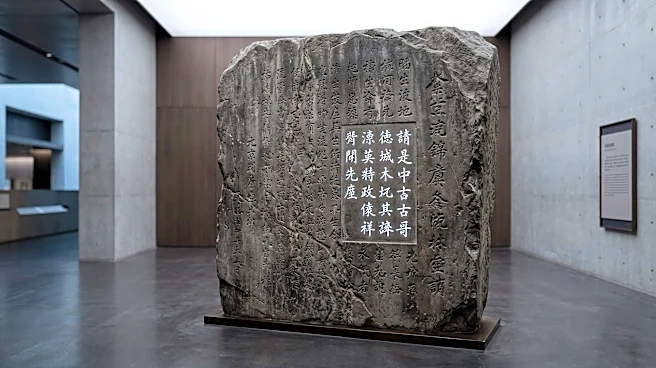
structure and textual meaning of the inscriptions. Ancient steles, which preserve historical records and calligraphy, often suffer from erosion, cracking, and other forms of deterioration, making their rubbings difficult to read. Traditional image enhancement can sharpen inscriptions but may inadvertently alter characters, while language-focused systems might reconstruct text without preserving the original calligraphy. SteleSR addresses this by focusing on the edges and continuity of individual strokes and using textual information to ensure reconstructed characters remain recognizable. Researchers created a benchmark called SISTR from historical inscription rubbings from the National Library of China, spanning the Ming and Qing dynasties and the Republic of China, to train and test the system. This benchmark included both clear and heavily degraded examples.
Why It's Important?
The development of SteleSR is significant for cultural heritage preservation, particularly in the context of ancient texts and historical records. By accurately restoring damaged inscriptions, the system ensures that valuable historical information, including calligraphic styles and textual content, is not lost to deterioration. This technology offers a more faithful digital reconstruction than previous methods, which often sacrificed the authenticity of the original writing for clarity or vice versa. The ability to preserve the unique visual character of ancient calligraphy while making the text more readable for both human researchers and optical character recognition software has profound implications for historical studies and archaeological research. It allows for a deeper understanding of past societies, their languages, and their artistic expressions, which might otherwise remain obscured by centuries of damage. This advancement could also facilitate broader access to these historical documents for scholars worldwide.
What's Next?
Future developments for SteleSR are expected to extend its application to a wider range of writing systems and historical materials beyond Chinese inscriptions. Researchers also aim to reduce the computational demands of the system, which currently requires substantial resources for creating realistic simulated damage using large vision models. The system's reliance on a pretrained character-recognition model means it may struggle with very rare character forms or unusual historical scripts, indicating an area for further refinement. The ongoing challenge is to continue recovering lost information from ancient artifacts without allowing digital restoration to inadvertently overwrite or misrepresent the original character of the artifact. This will involve continuous improvement in the AI's ability to discern subtle nuances in damaged texts and adapt to diverse historical contexts.
Beyond the Headlines
The ethical implications of digital restoration are a key consideration. While SteleSR aims to preserve the original character of inscriptions, any digital intervention raises questions about authenticity and interpretation. The system's ability to make previously unreadable texts accessible could lead to new historical discoveries and reinterpretations of established narratives. However, it also places a greater responsibility on researchers to understand the limitations of the technology and to clearly differentiate between the original artifact and its digitally enhanced representation. This technology could set a precedent for how other forms of damaged cultural heritage, such as ancient manuscripts or artworks, are preserved and studied. The interplay between advanced AI and historical research highlights a growing trend where technology not only aids in preservation but also shapes our understanding of the past, potentially influencing cultural identity and historical discourse.