





What's Happening?
Wyoming Republican Representative Harriet Hageman has publicly criticized California, asserting that the state's mismanagement of water resources has exacerbated the ongoing Colorado River water crisis. According to Hageman, California has prioritized
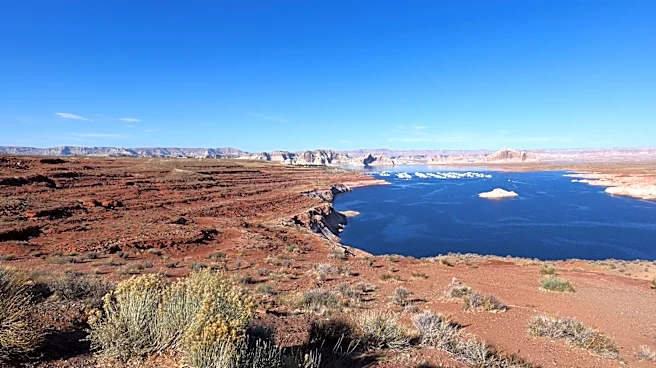
spending on projects like high-speed rail over essential water infrastructure upgrades, contributing to the record-low levels observed in Lake Powell and Lake Mead. Hageman, who previously worked as a water and natural resources attorney, highlighted that California's water infrastructure largely dates back to the 1960s, despite a significant population increase since then. She argues that California should be held accountable for its failure to adequately address its water needs, suggesting that the state should aggressively pursue desalination of Pacific Ocean water as a solution. Hageman also noted that Wyoming has never utilized its full allocation of the Upper Basin's water, and therefore, its supply should not be depleted to compensate for other states' issues.
Why It's Important?
This issue is important as it underscores the escalating tensions and potential legal disputes among Western U.S. states over dwindling water resources from the Colorado River. The accusations from Representative Hageman highlight a significant inter-state conflict, particularly between Upper Basin states (Wyoming, Colorado, Utah, New Mexico) and Lower Basin states (California, Arizona, Nevada). The declining water levels in critical reservoirs like Lake Powell and Lake Mead threaten not only water supply for millions but also hydroelectric power generation, which could have widespread economic and societal impacts. If the situation escalates to a legal battle, potentially before the U.S. Supreme Court, it could redefine water rights and allocations established by the 1922 Colorado River Compact, affecting agricultural practices, urban development, and environmental conservation across the region. The debate also brings into focus the differing priorities of state governments regarding infrastructure investment versus other public projects.
What's Next?
The immediate future may see continued political rhetoric and potential legal challenges as states attempt to secure their water rights. Representative Hageman anticipates that Arizona, facing its own water challenges, might initiate legal action against other states regarding the Colorado River Compact. Such a scenario would likely involve complex arguments over the interpretation of the 1922 Compact, with Upper Basin states potentially arguing for a 'non-depletion' interpretation. California may face increased pressure to invest in alternative water solutions, such as desalination plants, to reduce its reliance on the Colorado River. The Department of the Interior's new 10-year plan for the Colorado River will also be a critical factor, as states like Arizona are already expressing concerns over proposed water cutbacks. The outcome of these discussions and potential legal proceedings will significantly influence water management policies and resource allocation for decades to come.
Beyond the Headlines
Beyond the immediate political and legal ramifications, this conflict highlights deeper issues concerning long-term water sustainability in the American West, particularly in the face of climate change and population growth. The debate over the Colorado River's future raises ethical questions about equitable resource distribution, the balance between agricultural and urban water needs, and the responsibility of states to invest in resilient infrastructure. The suggestion of desalination as a solution for California, while technologically feasible, also brings into focus the high energy consumption and environmental impact associated with such processes. This situation could trigger a broader re-evaluation of water conservation strategies, interstate cooperation mechanisms, and the role of federal oversight in managing shared natural resources. It also underscores the vulnerability of critical infrastructure to environmental changes and the need for proactive, rather than reactive, policy-making.