
What's Happening?
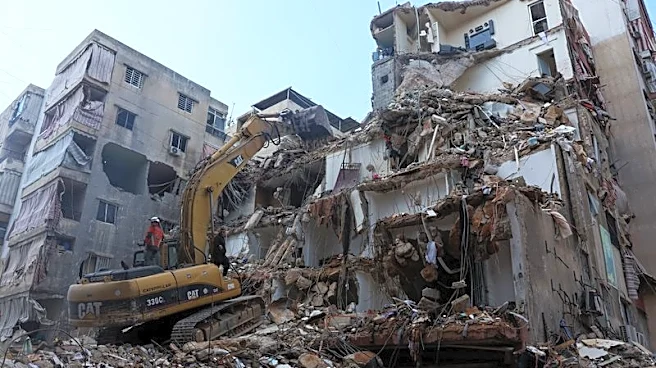
Recent negotiations between Israel and Lebanon, held in Washington, have brought attention to the ongoing conflict involving Hezbollah. Despite a fragile ceasefire, tensions remain high as Hezbollah continues
to fire into northern Israel. The talks aim to address several key issues, including the disarmament of Hezbollah, border disputes, and Lebanon's capacity to enforce any potential agreements. The border disputes are largely technical, involving minor territorial disagreements. A significant point of contention is the Shebaa Farms area, which is claimed by Lebanon but considered Syrian territory by Israel. The resolution of this issue depends on Syria's stance. Discussions also include the possibility of establishing demilitarized zones, similar to those in agreements with Egypt and Syria, to enhance security. However, the central challenge remains Hezbollah's military presence, which complicates the prospects for a lasting peace agreement.
Why It's Important?
The outcome of these negotiations holds significant implications for regional stability in the Middle East. Hezbollah's disarmament is a critical issue, as the group wields considerable military power and can act independently of the Lebanese government. A successful agreement could lead to a more stable ceasefire and potentially pave the way for broader peace efforts. However, Lebanon's internal political dynamics, including the influence of Hezbollah within the government and military, pose substantial obstacles. The international community, particularly the United States, is keen on preventing a prolonged conflict, which could have wider geopolitical repercussions. The talks also reflect broader regional tensions, involving actors like Syria and Iran, whose positions could influence the negotiations' outcomes.
What's Next?
The immediate future of the Israel-Lebanon talks remains uncertain. While the United States is pushing for a ceasefire, Israel has not agreed to halt military actions, and Hezbollah continues its operations. The potential for a full peace agreement seems distant, given the current gaps and Lebanon's complex internal situation. However, there is a possibility for incremental progress, such as improved ceasefire conditions and enhanced monitoring mechanisms. The international community may continue to exert pressure on both sides to reach a temporary or partial agreement. Long-term peace would likely require significant changes in Hezbollah's status and broader regional shifts, including Iran's role in the conflict.