





What's Happening?
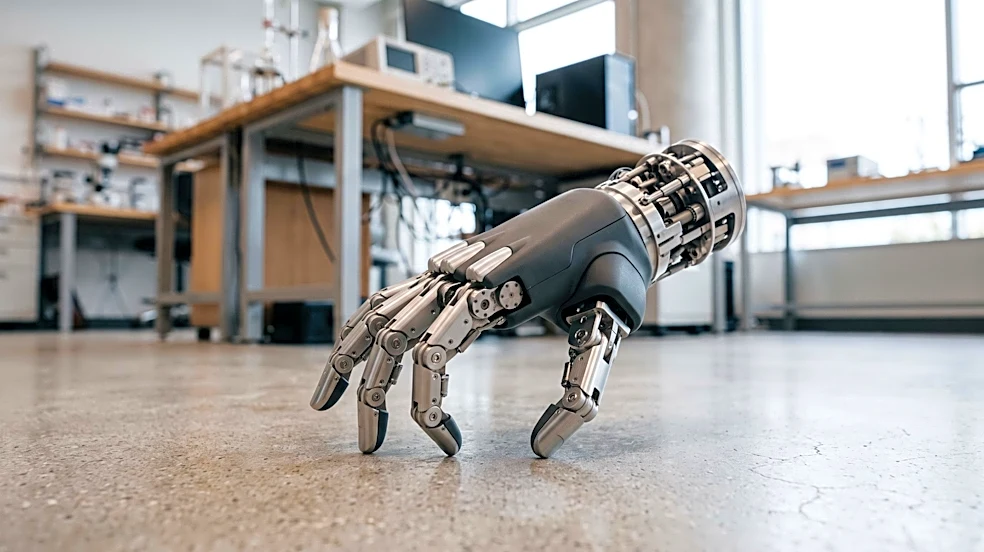
Scientists at ETH Zurich have successfully demonstrated a novel approach to robotic mobility by enabling an anthropomorphic robotic hand to use its fingers for both manipulation and locomotion. This research, detailed in a paper titled 'Fingers as Legs:
Learning Self-Supported Locomotion and Manipulation with an Anthropomorphic Hand' by Amirhossein Kazemipour, Hehui Zheng, and Robert Katzschmann, utilized an off-the-shelf robotic hand from WUJI. Instead of attaching the hand to a separate mobile platform or robot arm, the researchers trained it to support its own weight and move independently. The system, which incorporates onboard power and computation, can crawl, steer, and recover from falls. It also performs manipulation tasks while moving, such as pressing keyboard keys and pushing objects towards targets. This development represents a significant step towards creating compact, self-contained mobile manipulators.
Why It's Important?
This innovation holds significant implications for the field of robotics, particularly in the U.S. and globally, by challenging traditional designs that separate manipulation and locomotion systems. By integrating these functions into a single unit, the research could lead to more compact, versatile, and efficient robots. This could benefit industries requiring robots to operate in confined or complex environments, such as manufacturing, logistics, and even disaster response, where space and maneuverability are critical. The ability of a robotic hand to move itself reduces the need for additional, often bulky, mobility mechanisms, potentially lowering manufacturing costs and increasing deployment flexibility. Furthermore, the use of reinforcement learning in simulation, calibrated with physical hardware, demonstrates an advanced methodology for developing complex robotic behaviors, which could accelerate the development of more intelligent and adaptable robotic systems across various applications.
What's Next?
The research paves the way for further development in integrated robotic systems. Future work will likely focus on refining the locomotion and manipulation capabilities, potentially exploring more complex terrains and a wider range of manipulation tasks. The increasing role of commercially available dexterous hands, such as those from WUJI, as research platforms suggests a trend towards more accessible and standardized hardware for robotic innovation. The integration of teleoperation systems, like the WUJI Glove, with advanced learning techniques, including Nvidia Isaac Teleop, will continue to generate valuable data for training embodied AI and robotic manipulation models. This data-driven approach will enable robots to learn from human demonstrations, leading to more autonomous and sophisticated robotic behaviors in real-world scenarios. The long-term goal is to create robots that can seamlessly transition between movement and intricate tasks without external support.
Beyond the Headlines
This research highlights a fundamental shift in how robotic systems are conceived, moving towards a more bio-inspired design where form and function are deeply intertwined. The concept of 'fingers as legs' blurs the lines between different robotic functionalities, suggesting a future where robots are not merely tools but integrated, adaptable entities. This could lead to ethical considerations regarding the autonomy and capabilities of such advanced robots, particularly as they become more self-sufficient and capable of navigating and interacting with their environments independently. The development also underscores the growing importance of simulation-based training and reinforcement learning in robotics, which allows for rapid iteration and optimization of complex behaviors before deployment in physical hardware. This approach could accelerate the pace of robotic innovation, potentially leading to breakthroughs in areas like prosthetics and human-robot interaction, where seamless integration of movement and manipulation is paramount.