



What's Happening?
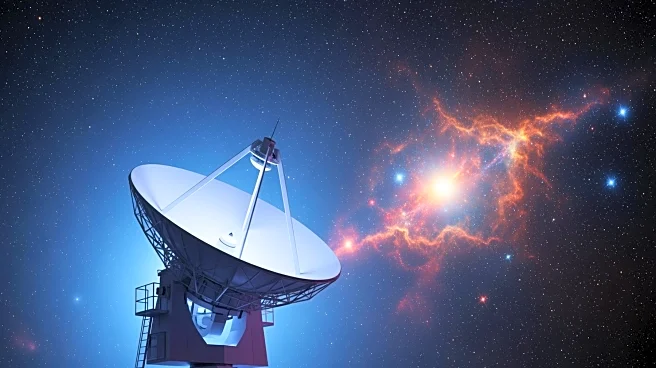
Astronomers have successfully detected radio waves from a rare Type Ibn supernova, providing new insights into the final years of a massive star's life before it explodes. This discovery, published in The Astrophysical Journal Letters, was made possible
by the National Science Foundation's Very Large Array radio telescope in New Mexico. The research team, led by Raphael Baer-Way, a Ph.D. student at the University of Virginia, tracked faint radio emissions from the supernova over 18 months. These emissions revealed gas expelled by the star a few years before its explosion, information that optical telescopes cannot capture. The study suggests that the star was likely part of a binary system, with interactions between the two stars contributing to the significant mass loss observed before the explosion.
Why It's Important?
This breakthrough offers a new method for studying the death of massive stars, which has traditionally relied on visible light observations. The ability to use radio waves to examine the final stages of a star's life provides a more detailed understanding of stellar evolution and the processes leading to supernovae. This research could significantly impact the field of astronomy by allowing scientists to study stars in distant galaxies that are too faint to observe in detail with optical telescopes. The findings also highlight the importance of binary systems in the mass loss processes of stars, which could lead to a reevaluation of existing models of stellar death.
What's Next?
The next phase of research will involve examining a larger number of supernovae to determine the prevalence of these dramatic mass-loss episodes. This will help scientists understand how common such events are and what they reveal about the evolution of stars. The study's findings suggest that radio telescopes should be pointed at potential supernovae earlier than previously assumed to capture their fleeting radio signals. This approach could open new avenues for research and lead to further discoveries about the life cycles of stars.