







What's Happening?
The University of Vermont (UVM) has been awarded a five-year, $19 million federal grant from the National Science Foundation (NSF) to create the National Connectomics and Ultrastructure Volume Observatory (NCUVO). This initiative will transform a research
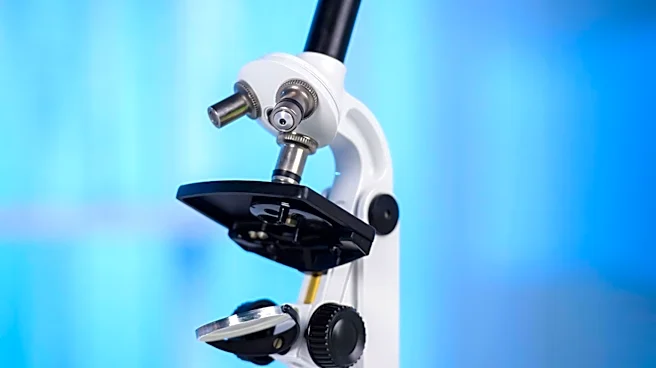
building in Burlington, Vermont, into the central hub for a new national science observatory. The NCUVO aims to utilize advanced electron microscopy, artificial intelligence, and powerful computing networks to visualize cells and brain circuits in three dimensions, enabling scientists to study structures too small for traditional light microscopes. Of the total grant, $15.68 million is allocated to UVM, with the remaining $3.32 million going to the University of California San Diego. UVM President Marlene Tromp highlighted the transformative nature of this research, emphasizing the university's leadership role in this national endeavor. The project builds upon previous work by Davi Bock, a neuroscientist at UVM's Larner College of Medicine, whose lab produced the first complete wiring map of an adult fruit fly's brain using electron microscopy.
Why It's Important?
This significant NSF grant positions the University of Vermont as a national leader in neuroscience and advanced imaging, fostering inter-institutional collaboration with UC San Diego. The establishment of NCUVO will accelerate scientific understanding of complex biological structures, particularly in the brain, by providing unprecedented three-dimensional views at a cellular and synaptic level. This advancement has the potential to revolutionize medical research, offering new insights into neurological diseases and conditions. The integration of artificial intelligence with high-throughput electron microscopy and advanced computing will set new standards for biological imaging and data analysis. Furthermore, the project includes four pilot research initiatives focusing on critical areas such as memory, vision, parasitic infections, and single-cell structures, demonstrating the broad applicability and potential impact of the observatory's capabilities across various biological disciplines. The initiative also emphasizes training the next generation of microscopists, ensuring a skilled workforce for future scientific breakthroughs.
What's Next?
The NCUVO project will proceed with the establishment of its coordinating hub at UVM's Firestone Medical Research Building in Burlington, where the high-throughput electron microscope will be housed. Data processing and storage will be supported by the Vermont Advanced Computing Center, while UC San Diego will contribute expertise in sample preparation, advanced microscopy, and data management through the San Diego Supercomputer Center. The four pilot research projects, spanning areas from mouse hippocampal connections to retinal circuitry and parasitic studies, will commence, utilizing the observatory's advanced capabilities. The initiative also plans to develop educational materials and undergraduate teaching programs, with UVM assistant professor Molly Stanley coordinating outreach efforts. Over the next five years, the project will focus on designing, building, and testing the end-to-end imaging pathway of the observatory, with ongoing efforts to integrate AI for data analysis and interpretation. This will likely lead to new discoveries and publications in neuroscience and related fields.
Beyond the Headlines
The NCUVO project represents a significant step towards understanding the intricate architecture of life at its most fundamental level, moving beyond the limitations of traditional microscopy. The ethical implications of advanced AI in scientific research, particularly in data interpretation and analysis, will be a continuous consideration, ensuring responsible development and application. The project's focus on mapping brain structures could also inform the development of more energy-efficient computing systems, drawing inspiration from biological brain architecture, as evidenced by recent investments in AI startups exploring similar models. This initiative underscores a broader trend in scientific research towards large-scale, collaborative observatories that integrate diverse technologies to tackle complex biological questions. The long-term impact could extend to the development of novel diagnostic tools, therapeutic strategies, and a deeper philosophical understanding of consciousness and biological intelligence.