


What's Happening?
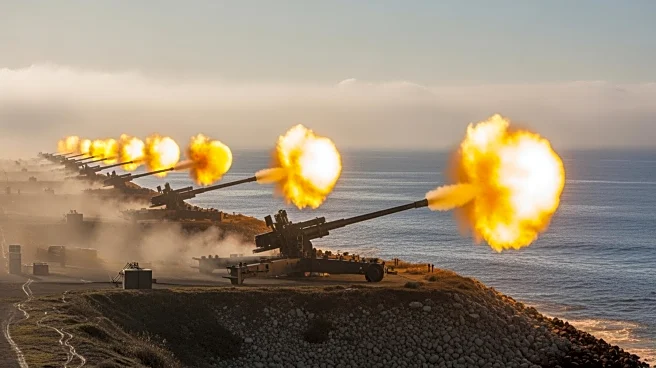
China has initiated a series of large-scale live-fire military exercises around Taiwan, following a record-setting $11 billion U.S. arms sale to the island. The drills, named 'Justice Mission 2025,' involve high-volume rocket fire into the Taiwan Strait,
with the intent to demonstrate China's military capabilities and send a message against Taiwan's cooperation with foreign powers, particularly the United States. Concurrently, China has imposed sanctions on 20 American defense technology companies. The exercises are seen as a response to the U.S. arms deal, which includes advanced military equipment for Taiwan. The People's Liberation Army (PLA) has stated that these actions are a warning against any attempts at Taiwanese independence and a demonstration of China's readiness to counter such moves.
Why It's Important?
The military exercises underscore the escalating tensions between China and Taiwan, with significant implications for U.S.-China relations. The U.S. arms sale to Taiwan is part of a broader strategy to bolster Taiwan's defense capabilities amid increasing Chinese military pressure. China's response, including sanctions on U.S. companies and military drills, highlights the geopolitical stakes involved. This situation could affect global markets, particularly in the defense sector, and influence international diplomatic relations. The U.S. maintains a policy of strategic ambiguity regarding military intervention in Taiwan, which adds complexity to the regional security dynamics. The involvement of Russia, expressing support for China, further complicates the international response to the Taiwan issue.
What's Next?
The continuation of military exercises by China suggests a sustained period of heightened military activity in the Taiwan Strait. The U.S. and its allies may need to reassess their strategic positions and diplomatic approaches to address the growing tensions. Potential responses could include increased military presence in the region or diplomatic efforts to de-escalate the situation. The international community will be closely monitoring the developments, as any miscalculation could lead to broader conflict. Taiwan's response to these exercises and its future defense strategies will also be critical in shaping the regional security landscape.
Beyond the Headlines
The situation raises questions about the future of cross-strait relations and the potential for conflict in the region. The exercises are part of a broader Chinese strategy to assert its claims over Taiwan and deter foreign intervention. The sanctions on U.S. companies could have long-term impacts on the global defense industry, affecting supply chains and international partnerships. Additionally, the involvement of Russia indicates a potential alignment of interests between China and Russia, which could influence global power dynamics. The situation also highlights the challenges of maintaining peace and stability in a region with complex historical and political tensions.