







What's Happening?
Recent conflicts in Ukraine, Nagorno-Karabakh, and Gaza demonstrate that tanks fighting in isolation, without integrated support, suffer unsustainable losses. Conversely, tanks operating within a combined arms team remain crucial for decisive battles,
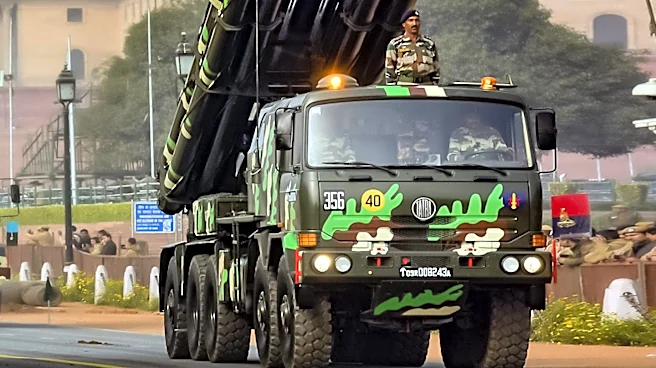
exploiting success, and holding ground. This observation is particularly relevant for India, which needs to evolve its armored combat strategy from a platform-centric approach to a capability-centric modernization. The focus should shift from merely improving individual tanks to enhancing the entire armored combat system. This involves implementing a uniform battle management system across formations, establishing a common operational picture down to the brigade level, and integrating sensors, drones, artillery, and air defense into a cohesive network. Additionally, attention must be paid to less glamorous but vital components of the order of battle, such as organic air defense for armored formations, which is identified as one of the least modernized elements of the mechanized force.
Why It's Important?
For the U.S. and its defense industry, the lessons from these conflicts underscore the global shift towards integrated warfare and the obsolescence of single-platform dominance. India's strategic re-evaluation of its armored combat capabilities presents significant opportunities for U.S. defense contractors specializing in advanced battle management systems, integrated sensor technologies, drone warfare, and sophisticated air defense solutions. A more capable and integrated Indian military could also contribute to regional stability, particularly in areas of shared security interests. Conversely, a failure to adapt could leave India vulnerable to modern threats, impacting its defense posture and potentially creating instability in a critical geopolitical region. The emphasis on a 'system, not just a platform' approach highlights the growing demand for comprehensive defense solutions rather than individual hardware sales, influencing future defense procurement trends globally.
What's Next?
India is expected to prioritize investments in a comprehensive armored combat system that integrates various military assets. This will likely involve significant procurement and development in areas such as advanced battle management systems, networked sensors, drones for reconnaissance and attack, and enhanced air defense capabilities specifically designed to protect armored formations. The shift will also necessitate extensive training and doctrine changes to ensure effective coordination and utilization of these integrated systems. Defense industries, both domestic and international, will be vying to provide the necessary technologies and expertise. The success of this modernization effort will be crucial for India's military effectiveness in future conflicts and its ability to project power and maintain regional security.
Beyond the Headlines
The insights from the Nagorno-Karabakh and Ukraine conflicts extend beyond military tactics, highlighting a broader paradigm shift in modern warfare. The vulnerability of isolated tanks reflects the increasing importance of information dominance, real-time intelligence, and networked operations in contemporary battlefields. This evolution challenges traditional military doctrines that often emphasized individual weapon platforms. The need for a 'capability-centric' approach suggests that future military success will depend less on sheer numbers of hardware and more on the seamless integration of diverse technologies and human intelligence. This has profound implications for defense spending, research and development, and international military cooperation, pushing nations to invest in complex, interconnected systems rather than standalone assets. It also raises ethical questions about the increasing automation and data-driven nature of warfare, and the potential for new forms of conflict and vulnerability.