




What's Happening?
NASA is developing plans to utilize autonomous robots for constructing essential infrastructure on the Moon, including landing pads, roads, radiation shielding, and habitats. This initiative aims to overcome the significant costs and logistical challenges
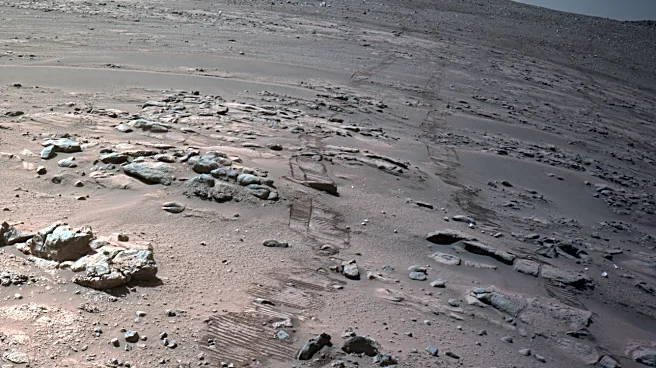
associated with transporting building materials from Earth. The strategy involves using lunar soil, known as regolith, as the primary construction material. Robots are deemed the most practical solution due to the Moon's hazardous environment, communication delays with Earth, and the absence of a satellite positioning system. The projected work sequence includes rovers scanning sites with LiDAR, clearing rocks, grading surfaces, and then using platforms to spread, compact, and laser-fuse regolith into hexagonal tiles. Multi-robot teams, coordinated by AI tools and software like Lunar Outpost's MARS, are being designed to operate autonomously, making decisions on-site and adapting to changing conditions. This approach is crucial for establishing a lasting human presence on the lunar surface.
Why It's Important?
The development of autonomous lunar construction has profound implications for the future of space exploration and the U.S. space industry. By enabling on-site construction using lunar resources, it significantly reduces the economic burden and logistical complexity of establishing a permanent human presence beyond Earth. This innovation could accelerate NASA's Moon to Mars initiative, fostering advancements in robotics, artificial intelligence, and material science. The ability to build infrastructure on the Moon independently of Earth's supply chain could open new avenues for scientific research, resource extraction, and even space tourism. Furthermore, the technologies developed for lunar construction, such as advanced robotics and AI for autonomous operations, could have terrestrial applications, benefiting industries like automated construction, mining, and disaster response. This initiative positions the U.S. at the forefront of space infrastructure development, potentially creating new economic opportunities and solidifying its leadership in space exploration.
What's Next?
NASA's lunar construction plan is expected to unfold in stages, beginning with small-scale demonstrations using landers to test remote operations and explore regolith materials. Early missions will focus on validating Earth-based tests and ensuring their accuracy under lunar conditions. The roadmap progresses from creating landing pads and blast walls to developing basic habitats and eventually a complete lunar base. Future steps include refining multi-robot coordination software and exploring lower-energy construction methods, such as stacking unprocessed stones. The reliability of machines handling irregular materials and the correlation between Earth tests and lunar results remain key areas for further investigation. Small, incremental missions will be crucial in proving individual capabilities, with the ultimate goal of having the first permanent lunar structures built and inspected by robots before astronauts inhabit them. This phased approach aims to systematically address technical challenges and build confidence in autonomous lunar construction capabilities.
Beyond the Headlines
The shift towards autonomous robotic construction on the Moon represents a fundamental change in how humanity approaches extraterrestrial habitation. It raises ethical considerations regarding the role of AI and robotics in pioneering new frontiers, potentially minimizing human risk but also altering the nature of exploration. Legally, it could necessitate new international frameworks for resource utilization and property rights on celestial bodies. Culturally, the establishment of permanent lunar bases built by robots could inspire a new generation of scientists and engineers, fostering a deeper connection with space exploration. This development also highlights a long-term shift towards self-sufficiency in space, where human outposts are not merely extensions of Earth but self-sustaining entities. The challenges of operating in extreme environments, coupled with the need for precise autonomous decision-making, will push the boundaries of current technological capabilities, leading to innovations that could redefine our understanding of construction, automation, and human-robot collaboration.