
What's Happening?
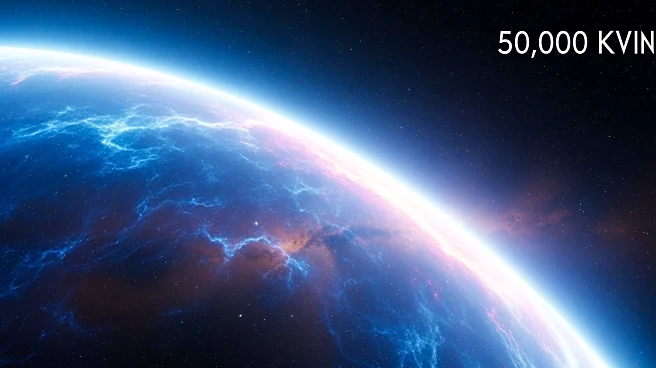
NASA's Voyager 1 and Voyager 2 spacecraft have detected a searing-hot region at the edge of the solar system, where the Sun's influence ends and interstellar space begins. This boundary zone, identified
as the heliosheath, exhibits temperatures spiking to an estimated 30,000 to 50,000 kelvin. The region, beyond Pluto's orbit, forms a thermal barrier far hotter than the space within the Sun's magnetic reach. Despite the extreme temperatures, the low particle density means the plasma does not transfer heat effectively, allowing the spacecraft to remain undamaged. These findings revise the understanding of how the solar system interfaces with the galaxy.
Why It's Important?
The discovery of this high-temperature region at the solar system's edge is crucial for understanding the boundary between solar and interstellar space. It challenges existing models of the heliosphere and its interaction with the interstellar medium. The data suggest that the heliosphere's outer boundary is more dynamic and permeable than previously thought, allowing for particle exchange with interstellar space. This has implications for understanding cosmic ray propagation and the solar system's protective mechanisms against galactic radiation. The findings also provide insights into the magnetic field alignment between the heliosphere and interstellar space, which could influence future space exploration and research.
What's Next?
NASA's heliophysics division will continue to analyze data from the Voyager missions to refine models of the Sun's magnetic and particle fields on a galactic scale. Future missions, such as the Interstellar Boundary Explorer (IBEX) and MAVEN, will contribute to this research effort. Scientists aim to understand the variability of the heliopause and its impact on the solar system's interaction with the galaxy. Further studies may focus on the magnetic field alignment and particle leakage observed by the Voyager spacecraft, providing a more comprehensive picture of the solar system's outer limits and its role in the broader cosmic environment.