




What's Happening?
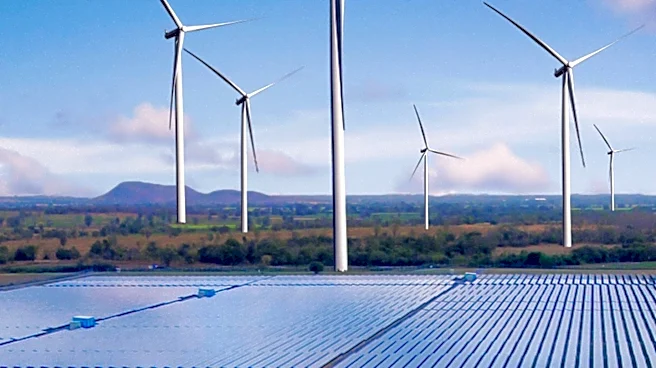
The International Renewable Energy Agency (IRENA) has indicated that the world is projected to add less clean energy capacity in 2026, marking the first such slowdown in five years. This deceleration is primarily attributed to inadequate transmission
networks and existing trade barriers. While solar and wind capacity growth has been consistent since 2021, IRENA Director-General Francesco La Camera highlighted a significant slowdown in renewables deployment in China. This slowdown is due to 'curtailment,' where clean power is rejected when the grid reaches its capacity limits. La Camera emphasized that the core issue is a mismatch between the generation capacity of clean energy and the infrastructure required to distribute and transmit that electricity. For instance, China, a major renewable energy producer, reportedly turned away enough clean energy to power Mexico for a year in the first half of 2026, and similar issues are observed in nations like Australia and Japan.
Why It's Important?
This projected slowdown in clean energy additions carries significant implications for global efforts to combat climate change and achieve energy security. Renewable energy is crucial for reducing global emissions, and a decrease in its deployment could hinder progress toward slowing global warming, as highlighted by a recent United Nations report calling for 'urgent and stringent' emission cuts. For the U.S., while the immediate impact might seem international, global energy trends directly influence energy markets, technological advancements, and policy decisions. A constrained global clean energy supply could affect the cost and availability of renewable technologies, potentially impacting U.S. clean energy initiatives and investments. Furthermore, the challenges faced by other nations in grid integration and transmission infrastructure could serve as a cautionary tale or a learning opportunity for U.S. policymakers and utility companies as they expand their own renewable energy portfolios.
What's Next?
The immediate future will likely involve increased scrutiny on grid infrastructure development and policies aimed at overcoming transmission bottlenecks. IRENA has not provided a specific numerical forecast for the expected growth slowdown, but the warning suggests that governments and energy stakeholders will need to prioritize investments in grid modernization and expansion. Addressing trade barriers that impede the flow of renewable energy technologies and components will also be critical. Countries, including the U.S., may need to re-evaluate their energy policies to ensure that generation capacity is matched with robust transmission capabilities. The global community will be watching to see if the slowdown in China can be offset by increased capacity additions in other regions, though La Camera expressed skepticism about this possibility. The United Nations' call for 'urgent and stringent' emission cuts underscores the pressure on nations to accelerate, rather than decelerate, clean energy deployment.
Beyond the Headlines
The reported slowdown points to a deeper systemic challenge within the global energy transition: the often-overlooked complexity of infrastructure. While the focus is frequently on developing new renewable generation technologies, the ability to effectively integrate and deliver that power to consumers is equally vital. This situation highlights the need for a holistic approach that includes not only technological innovation but also significant investment in grid modernization, smart grid technologies, and cross-border energy cooperation. The 'curtailment' issue in China, where clean energy is produced but cannot be utilized, represents a significant economic and environmental inefficiency. It underscores the ethical imperative to ensure that generated clean energy is not wasted, especially given the urgency of climate action. This development could also spur innovation in energy storage solutions and distributed energy systems that can reduce reliance on centralized, often overstretched, transmission networks.