







What's Happening?
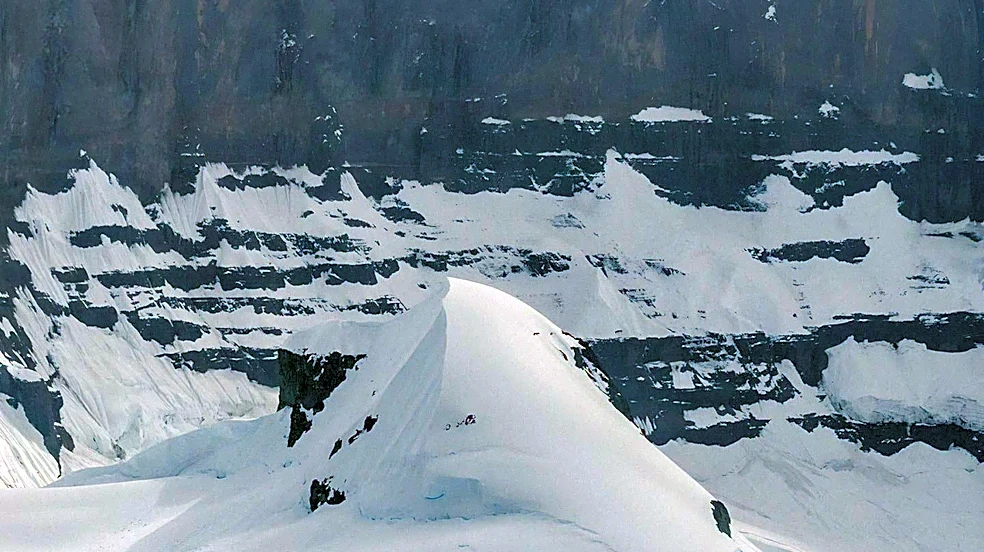
A new study has uncovered evidence of an enormous, mile-thick floating ice shelf that existed approximately 20,000 years ago in Baffin Bay, west of Greenland. This ice shelf played a crucial role in buttressing three of the largest ice sheets in northern
Canada and Greenland: the Greenland Ice Sheet, the Innuitian Ice Sheet, and the Laurentide Ice Sheet. Its disappearance, which occurred over a period of 500 to 1,000 years, contributed to hundreds of feet of sea level rise, shaping modern coastlines. The findings, published in Nature Geoscience, were made by scientists who initially sought to understand the destabilization of the Greenland Ice Sheet. Using sonar mapping and sediment cores, they discovered clear evidence of this previously unknown, massive ice shelf, which was at least half a mile thicker than any other known Northern Hemisphere ice shelf.
Why It's Important?
This discovery is significant because it provides critical new data for scientists modeling past and present ice shelves and glaciers. The ancient Baffin Bay ice shelf was comparable in size to some of the key ice shelves currently found in Antarctica. Its rapid disappearance within centuries, as highlighted by Robert Hatfield, an associate professor of geology at the University of Florida and co-author of the study, offers a concerning precedent for the stability of contemporary Antarctic ice sheets. Understanding how such a massive ice shelf vanished so quickly can lead to more accurate predictions regarding the rate at which Antarctic glaciers might melt and contribute to future sea level rise, directly impacting coastal communities and global climate patterns.
What's Next?
The new data from this study will be integrated into existing models used to predict the behavior of current ice sheets, particularly those in Antarctica. Researchers will likely focus on refining these models to better account for the potential rapid disintegration of large ice shelves, similar to what occurred in Baffin Bay. This could lead to updated projections for sea level rise and inform policy decisions related to coastal protection and climate change mitigation. Further research may also explore other regions for evidence of similarly large, ancient ice shelves to gain a more comprehensive understanding of their role in past climate dynamics.
Beyond the Headlines
The study underscores the dynamic and sometimes abrupt nature of Earth's climate history, revealing that even massive ice structures can disappear relatively quickly. The analogy of ice sheets as 'Gothic cathedrals' supported by 'flying buttresses' of ice shelves, as described by Hatfield, highlights the delicate balance that maintains these vast ice bodies. The rapid loss of such buttressing ice shelves could trigger a cascade of events leading to accelerated ice flow into the ocean. This research not only deepens our understanding of past geological processes but also serves as a stark reminder of the potential for rapid environmental change in the face of a warming climate, emphasizing the urgency of addressing current climate challenges.