







What's Happening?
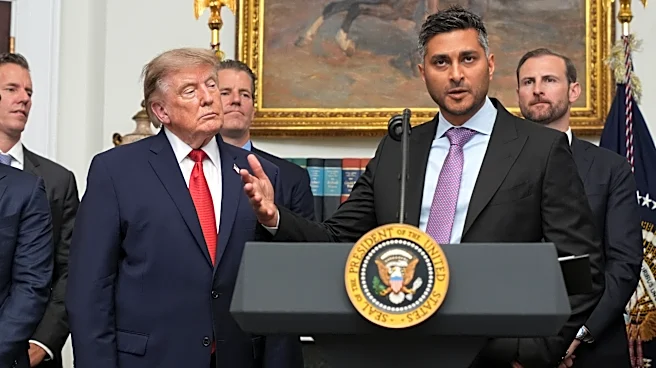
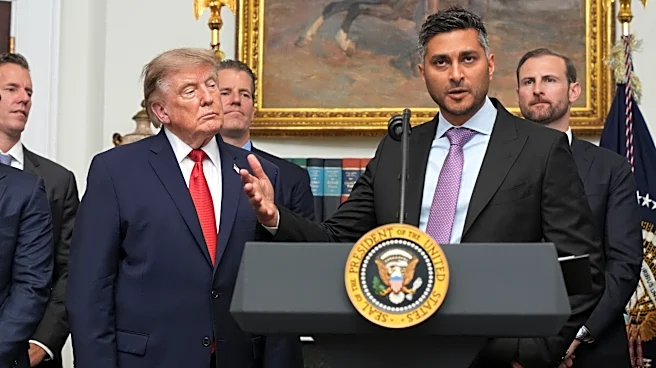
President Trump has agreed to a significant portion of a stringent ethics proposal within a broader cryptocurrency bill, which is slated for a key vote this week. According to three Republican senators, the agreement includes a provision that would grant
state attorneys general a meaningful role in enforcing the crypto measure if it becomes law. Initially, the bill only barred federally elected officials, their spouses, and federal judges from issuing digital assets. However, a core group of Democrats, alongside Republican Senator Thom Tillis and Senator Ruben Gallego, pushed for stronger conflict-of-interest measures, specifically advocating for state attorneys general to have the authority to enforce the law in addition to the Justice Department. An updated version of the bill will also require individuals with significant financial interests in cryptocurrency-issuing entities to either divest or place those assets in a blind trust.
Why It's Important?
President Trump's agreement to a new ethics provision in the cryptocurrency bill marks a significant development in the regulation of digital assets in the U.S. This move is crucial because it introduces a dual enforcement mechanism, empowering state attorneys general alongside the Justice Department to oversee the burgeoning crypto market. This expanded oversight could lead to more robust enforcement against illicit activities and conflicts of interest within the cryptocurrency space, potentially increasing investor confidence and market stability. However, it also raises questions about potential inconsistencies in enforcement across states and the possibility of politically motivated legal actions, as White House officials had previously expressed concerns about such a provision. The requirement for divestment or blind trusts for officials with significant crypto holdings aims to mitigate conflicts of interest, fostering greater transparency and integrity in public service, particularly as digital assets become more integrated into the financial landscape.
What's Next?
The cryptocurrency bill, now incorporating President Trump's agreed-upon ethics provisions, is scheduled for a key vote this week. The inclusion of the state attorneys general enforcement power and the divestment/blind trust requirement for officials' crypto holdings are critical elements that will be scrutinized. If the bill passes, it will establish a new regulatory framework for digital assets, potentially leading to a more structured and accountable cryptocurrency market. State attorneys general will then need to develop strategies and allocate resources to effectively exercise their new enforcement powers. The implementation of these provisions could also spark legal challenges regarding the scope of state authority versus federal oversight in the crypto space. Furthermore, the precedent set by this bill could influence future legislation concerning emerging technologies and financial instruments, as policymakers grapple with balancing innovation with consumer protection and ethical governance.
Beyond the Headlines
The agreement on the cryptocurrency bill's ethics provisions, particularly the role of state attorneys general, highlights a deeper tension within U.S. governance: the balance of power between federal and state authorities. While intended to enhance oversight and accountability in the crypto market, this dual enforcement mechanism could lead to a complex legal landscape. The potential for state attorneys general to use these powers as a 'political weapon,' as previously noted by White House officials, underscores the politicization of regulatory enforcement. This could result in varying interpretations and applications of crypto laws across different states, creating a fragmented regulatory environment that might either stifle innovation or provide loopholes. Moreover, the requirement for public officials to divest or blind trust their crypto assets sets a new standard for financial transparency in an era where digital wealth is increasingly significant, potentially influencing ethical guidelines for public service across other emerging asset classes.