
What's Happening?
One of Turkey's most renowned ancient burial mounds, popularly known as the Midas Tumulus, is now believed by experts at the ancient city of Gordion to be the tomb of Gordias, the father of the legendary
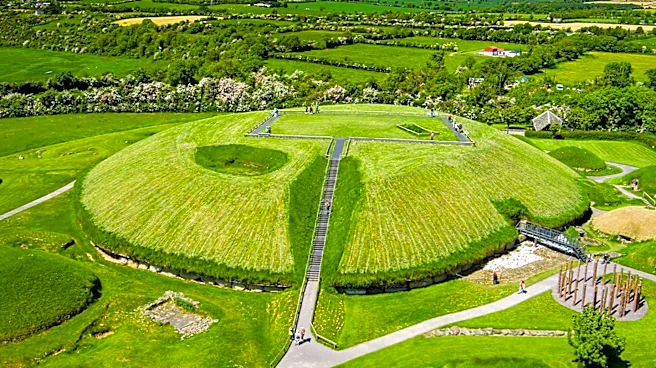
Phrygian King Midas. Located in Ankara's Polatlı district, the monumental tomb contains an exceptionally well-preserved wooden burial chamber dating back nearly 3,200 years, offering significant evidence of Phrygian funerary practices, woodworking, and metal craftsmanship. Despite its enduring popular association with King Midas, archaeological evidence suggests the monument was likely commissioned by Midas for his father after Gordias' death. Kadim Koç, chairman of the Gordion Foundation, noted that the association with Midas persisted due to the king's greater fame, even though initial reports from the 1957 excavation identified it as Gordias' tomb. The burial mound, approximately 53 meters high and 300 meters in diameter, houses a 6.15 by 5.15-meter wooden chamber constructed from juniper timber that has remarkably survived for millennia.
Why It's Important?
This clarification of the Midas Tumulus' occupant is crucial for accurately understanding Phrygian history and royal lineage. While King Midas is a more famous figure due to Greek mythology, identifying the tomb as that of his father, Gordias, provides a more precise historical context for the site. The tomb's exceptional preservation offers invaluable insights into the advanced craftsmanship of the Phrygians, particularly in woodworking and metalworking, as evidenced by the 99 fibulas (ancient brooches) found within. These artifacts demonstrate the sophistication of Phrygian society and its artistic capabilities. The ongoing study of Gordion, which was inscribed on the UNESCO World Heritage List in 2023, contributes significantly to our knowledge of ancient civilizations in Anatolia and their cultural practices, providing a clearer picture of the historical figures who shaped the region.
What's Next?
Archaeological research at Gordion will continue to focus on understanding the Phrygian civilization, its rulers, and its cultural practices. The site, with its numerous burial mounds, remains a rich source of historical information. Future studies may involve further analysis of the artifacts recovered from the Gordias tomb, including the textiles and wooden objects, to gain deeper insights into Phrygian daily life, technology, and artistic expression. The ongoing preservation efforts for the wooden burial chamber and other structures at Gordion will also be critical to ensure these historical treasures remain accessible for future generations of researchers and the public. Educational initiatives will likely aim to correct the popular misconception about the tomb's occupant, emphasizing the historical significance of Gordias and his era.
Beyond the Headlines
The enduring popular association of the tumulus with King Midas, despite archaeological evidence to the contrary, highlights the powerful influence of legend and mythology on historical perception. This phenomenon is common in archaeology, where popular narratives often overshadow factual discoveries. The story of Gordion and its rulers, including the legendary Gordian Knot, continues to captivate and offers a unique blend of historical fact and mythical lore. The site serves as a tangible link to a civilization that significantly impacted the ancient world, providing a window into the political, ceremonial, and artistic life of the Phrygian kingdom. The meticulous preservation of the wooden chamber also underscores the remarkable engineering and construction skills of ancient peoples, allowing modern researchers to study their techniques directly.