





What's Happening?
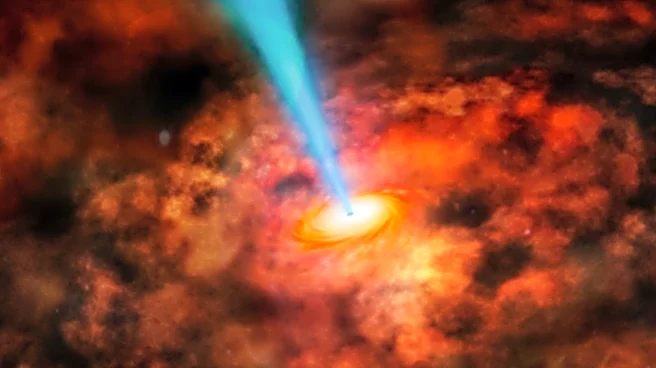
Astronomers using the European Space Agency's Euclid space telescope have discovered 31 black-hole-powered quasars in the early universe, including the most ancient and distant quasar ever seen. This quasar, shining with the light of a trillion suns,
existed just 670 million years after the Big Bang. Quasars are formed when supermassive black holes are surrounded by accretion disks, causing intense luminosity. The discovery is significant as it provides insight into how supermassive black holes grew rapidly after the Big Bang. The Euclid mission, launched in 2023, has significantly increased the number of known ancient quasars, allowing scientists to study them as a population for the first time.
Why It's Important?
The discovery of these ancient quasars is crucial for understanding the early universe and the rapid growth of supermassive black holes. It offers a unique opportunity to study the epoch of reionization, a period when the universe's 'dark ages' ended. This research could help solve mysteries about dark energy and dark matter, which are fundamental components of the universe. The Euclid telescope's ability to detect faint light from distant objects makes it a game-changer in astrophysics, providing a deeper understanding of cosmic history and the formation of galaxies.
What's Next?
The Euclid Wide Survey will continue to cover a third of the sky, potentially discovering more quasars and shedding light on the 'dark universe.' Scientists aim to use these findings to explore the nature of dark energy and dark matter further. The ongoing research will enhance our understanding of the universe's expansion and the role of supermassive black holes in galaxy formation. As the survey progresses, it may lead to new theories and models about the universe's early stages and its evolution.