


What's Happening?
Dr. Christi Erba, an assistant professor of physics and director of the Downing Planetarium at Fresno State, is a key member of an international scientific team. This team is conducting the TEMPOS (Treasury of Extremely Metal Poor O Stars) project, an ongoing
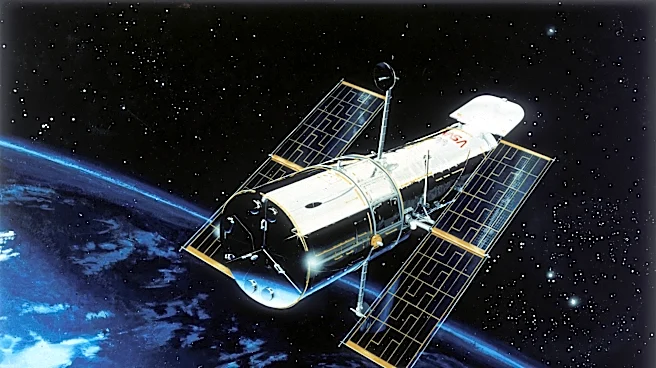
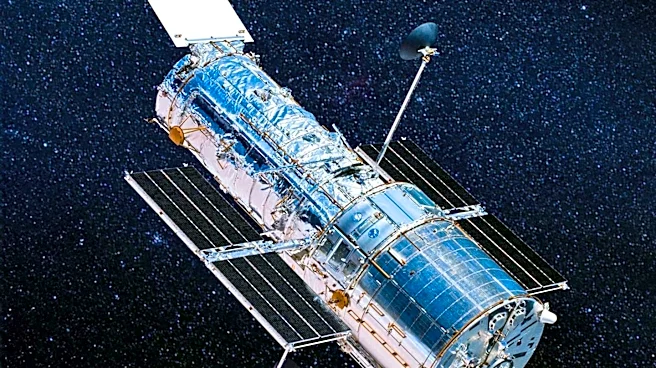
survey of 29 stars located in nearby galaxies. The research utilizes data from NASA’s Hubble Space Telescope and the Keck Observatory in Hawaii. The primary objective of TEMPOS is to investigate the composition of distant stars to gain a deeper understanding of the universe's history and to reconcile discrepancies between observed astronomical data and existing models of cosmic evolution. By analyzing ultraviolet and visible light from these stars, researchers aim to determine their luminosity, temperature, and chemical composition. The project focuses on O-type stars, which are massive, exceptionally bright, and detectable across vast distances. Dr. Erba has been involved with TEMPOS since her postdoctoral appointment at the Space Telescope Science Institute in Baltimore, and she continues her research at Fresno State.
Why It's Important?
This research is crucial for advancing humanity's understanding of the early universe. By studying distant stars, scientists are essentially looking back in time, as light from these celestial bodies takes tens of thousands of years to reach Earth. The TEMPOS project specifically examines stars in galaxies that are considered analogs to those in the early universe due to their low metal content. This approach helps overcome the limitations of current technology, which cannot individually examine the earliest stars directly. The findings from TEMPOS could significantly alter current models of stellar evolution and the universe's development. Understanding how massive stars formed and evolved in the early universe is vital because they are responsible for forging most elements heavier than hydrogen and helium, including those essential for biological life like carbon, silicon, and oxygen. These elements are dispersed into the universe through supernova explosions, influencing subsequent star and planet formation.
What's Next?
The TEMPOS team has already completed initial visible light surveys of stars in the Wolf-Lundmark-Melotte galaxy and the NGC 3109 galaxy, publishing a series of papers detailing the program and its initial results. The next phase of the research will focus on the four remaining galaxies included in the program. Dr. Erba and her colleagues will continue to analyze the data to further understand the diversity among massive stars, which has been greater than previously assumed. This ongoing work aims to refine models of stellar evolution and provide more accurate insights into the conditions of the early universe. The project also emphasizes the importance of making astronomy research accessible, with Dr. Erba expressing a passion for involving students from diverse backgrounds, particularly first-generation students at Fresno State, in scientific discovery.
Beyond the Headlines
The TEMPOS project highlights a fundamental challenge in astrophysics: reconciling observational data with theoretical models. The unexpected chemical signatures observed by the James Webb Space Telescope, which do not align with existing models of the universe, underscore the need for projects like TEMPOS. By studying metal-poor stars in nearby galaxies, researchers are creating a bridge to understand the conditions of the very early universe, where such stars were prevalent. This research also touches upon the profound connection between stellar processes and the potential for life, as massive stars are the cosmic factories for elements necessary for biological existence. The project's commitment to diversity in science, championed by Dr. Erba, also points to a broader shift in scientific communities to ensure that opportunities in cutting-edge research are inclusive and accessible to a wider range of talent, fostering future generations of astronomers and scientists.