
What's Happening?
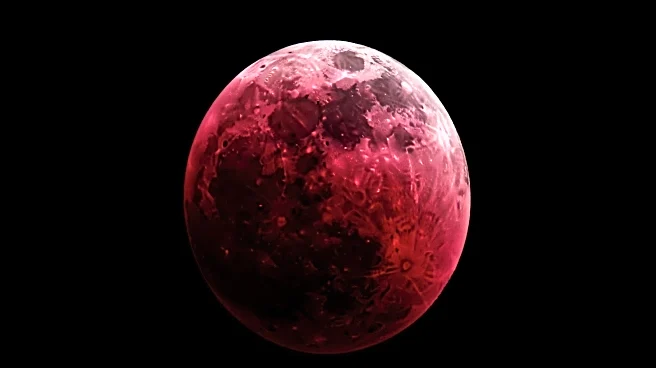
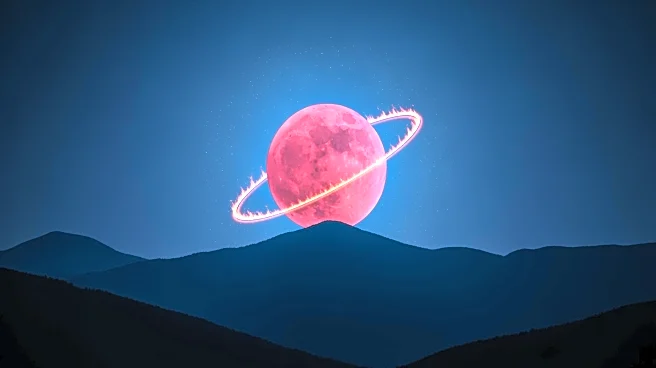
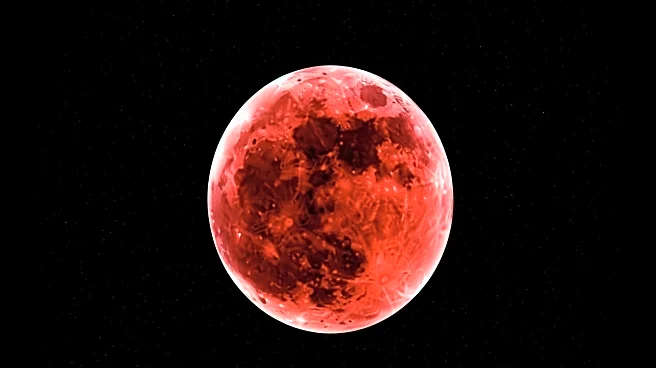
In 2026, a rare celestial event will captivate skywatchers with a 'Blood Moon' and a 'Ring of Fire' solar eclipse occurring in close succession. The Blood Moon, a total lunar eclipse, will take place on March 3, 2026, following a 'Ring of Fire' solar eclipse on February
17. During a Blood Moon, the Earth positions itself between the Sun and the Moon, casting a shadow that gives the Moon a reddish hue due to atmospheric refraction. This phenomenon is a result of the alignment of the Earth, Moon, and Sun, creating an 'eclipse season' where such events occur in close proximity. The Blood Moon will be visible in Florida during the early morning hours, with the Moon appearing low in the western sky. The 'Ring of Fire' solar eclipse, which occurred two weeks prior, was visible in remote regions such as East Antarctica and the Southern Indian Ocean, characterized by the Moon covering the Sun's center, leaving a ring-like appearance.
Why It's Important?
These celestial events are significant for both scientific and public interest reasons. They provide astronomers with opportunities to study atmospheric conditions based on the color variations of the Moon during the eclipse. The events also highlight the precise mechanics of celestial bodies and their orbits. For the public, such events offer a chance to engage with astronomy and appreciate the natural phenomena that occur in our solar system. The visibility of these events in specific regions, like Florida, can boost local interest in astronomy and science education, potentially inspiring future generations of scientists.
What's Next?
Following the Blood Moon, the next major celestial event in 2026 will be the 'Great European Eclipse' on August 12, a total solar eclipse visible from parts of Europe, including the Arctic, Greenland, Iceland, and Spain. This will be the first total solar eclipse visible from continental Europe in over two decades, promising to draw significant attention from both the scientific community and the public. Preparations for viewing and studying these events will likely involve collaborations between astronomers, educators, and media to maximize public engagement and scientific data collection.