
What's Happening?
In a groundbreaking study published in Nature Physics, researchers have successfully observed a fragile-to-strong transition in deeply supercooled water for the first time. This scientific breakthrough
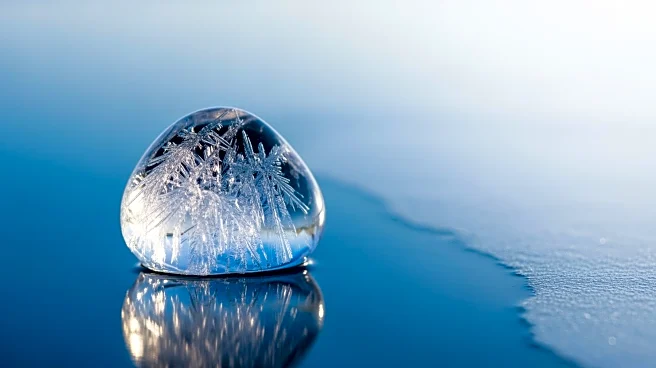
resolves a long-standing puzzle about water's anomalous properties when cooled below freezing without crystallization. The study, led by Prof. Kyung Hwan Kim from POSTECH and Prof. Anders Nilsson from Stockholm University, utilized an innovative experimental setup involving ultrafast X-ray free-electron lasers. By rapidly evaporating water droplets in a vacuum, the team was able to supercool the water to temperatures as low as -45°C. They then used femtosecond infrared laser pulses to induce small temperature changes and monitored the relaxation dynamics with X-ray scattering techniques. The results revealed a dynamic crossover at approximately 233 K, marking a significant advance in understanding water's behavior in the supercooled regime.
Why It's Important?
This discovery is crucial for advancing our understanding of water's unique properties, which are essential for life and numerous natural phenomena. The ability to experimentally observe the fragile-to-strong transition provides validation for decades of theoretical and simulation work. It also opens new avenues for research into water's behavior at low temperatures, which has implications for fields ranging from climate science to biological chemistry. By confirming that water's dynamic anomalies are due to a genuine transition, the study supports the theoretical framework that has been developed over the years. This could lead to improved models for predicting water's behavior in various environmental and industrial contexts.
What's Next?
The researchers plan to further investigate the microscopic mechanisms behind the observed transition. With improvements in experimental techniques, they aim to probe these underlying processes more directly. The study also sets the stage for exploring other phenomena in the supercooled temperature range, potentially leading to new insights into water's role in different scientific and practical applications. Future research may focus on extending these findings to other liquids and understanding how similar transitions might occur in different contexts.