







What's Happening?
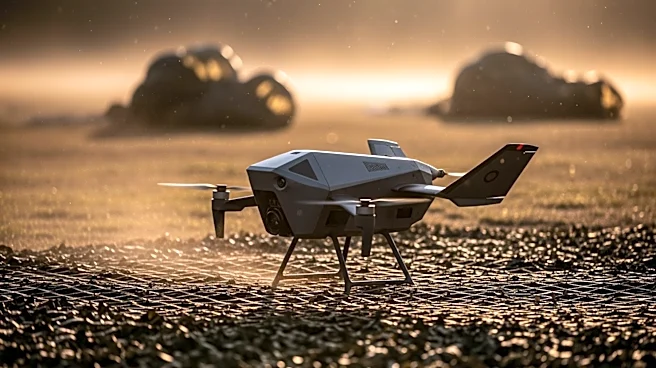
The U.S. Army's 82nd Airborne Division has completed its first training exercise using the Bumblebee V2, a newly acquired drone hunter-killer system. This training took place at Fort Bragg, North Carolina, where twenty paratroopers were trained to use
the Bumblebee to track and neutralize adversary drones. The Bumblebee V2 is a self-contained, autonomous drone equipped with Artificial Intelligence targeting software, allowing it to autonomously track and engage enemy drones. The system was acquired through a $5.2 million contract with Perennial Autonomy, with deliveries beginning in February. The Bumblebee V2 is designed to perform kinetic strikes, or 'hard kills,' by ramming into target drones, minimizing the need for external ammunition.
Why It's Important?
The integration of the Bumblebee V2 into military training represents a significant advancement in counter-drone warfare capabilities for the U.S. Army. This technology enhances the military's ability to neutralize enemy drones autonomously, reducing the risk to personnel and equipment. The use of such advanced systems is crucial as drones become increasingly prevalent in modern warfare. The Bumblebee V2's ability to act as its own ammunition reduces logistical challenges and potential collateral damage associated with traditional ammunition. This development could lead to broader adoption of autonomous systems in military operations, potentially reshaping tactics and strategies in drone warfare.
What's Next?
The Bumblebee V2 is expected to become a standard weapon in the U.S. military's arsenal, with further evaluations and potential deployments anticipated. As the Army continues to integrate this technology, it may influence future procurement and development of similar autonomous systems. The success of this training exercise could lead to expanded use of the Bumblebee V2 across other military divisions, enhancing the overall counter-drone capabilities of the U.S. armed forces. Additionally, the military may explore further advancements in AI and autonomous technologies to maintain a strategic edge in drone warfare.