




What's Happening?
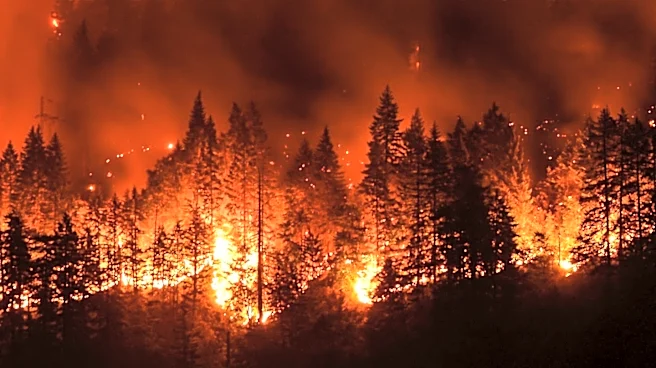
Wildfires in North American forests are becoming faster and more destructive, driven by climate change and other contributing factors, according to a new paper published in the journal Science Advances. Lead author Jonathan Coop highlights that the increased
speed and severity of these fires have significant long-term ecological consequences, potentially leading to permanent shifts from forested landscapes to non-forest conditions. This phenomenon is already evident in parts of the Southwestern U.S., California's Sierras, and portions of the interior West. The study emphasizes that the way fires burn today, characterized by high severity, appears incompatible with the persistence of dry-conifer forests, which have historically experienced lower-intensity fire regimes. This acceleration of fire activity is also expected to hasten changes in the distribution of forest types across the North American forest biome as species are forced to adapt to shifting climatic conditions.
Why It's Important?
The increasing speed and destructiveness of wildfires pose a critical threat to the ecological stability and future of North American forests. The potential for long-term ecosystem transitions from forests to non-forest conditions signifies a profound loss of biodiversity, habitat, and essential ecosystem services such as carbon sequestration, water regulation, and soil stability. This shift could have cascading effects on regional climates, local economies dependent on forest resources, and the overall resilience of natural systems. Furthermore, the incompatibility of current high-severity fire regimes with dry-conifer forest persistence indicates a fundamental challenge to traditional forest management and conservation strategies. The acceleration of changes in forest type distribution could also impact industries reliant on specific tree species and alter the aesthetic and recreational value of vast natural areas, affecting communities and tourism.
What's Next?
To address the escalating threat of faster and more destructive wildfires, Jonathan Coop recommends several policy responses. These include expanding the use of prescribed fire, allowing wildfires to burn when it is safe to do so, and enabling more Indigenous-led cultural burning practices. These methods aim to reduce the accumulation of brush, trees, and other fuels, thereby decreasing fire severity and protecting lives and property. The focus is shifting from solely stopping fires to better managing their presence within ecosystems. Implementing these strategies will require significant policy changes, increased funding for fire management, and a greater understanding and acceptance of controlled burning by the public and land managers. The success of these initiatives will be crucial in mitigating the long-term ecological transitions and preserving the health and diversity of North American forests.
Beyond the Headlines
The deeper implication of this research is a fundamental re-evaluation of humanity's relationship with fire in natural landscapes. For decades, the dominant approach has been fire suppression, leading to an unnatural accumulation of fuels that now contribute to more intense and uncontrollable blazes. The call for expanded prescribed burning and Indigenous-led cultural burning represents a paradigm shift towards recognizing fire as an integral, and often beneficial, ecological process. This shift involves not only scientific and policy changes but also a cultural re-education about fire's role in maintaining healthy ecosystems. It highlights the importance of traditional ecological knowledge, which has long understood the benefits of controlled fire. Embracing these practices could lead to more resilient forests, but it also requires overcoming public fear and bureaucratic hurdles, emphasizing the complex interplay between ecological science, cultural practices, and public policy in addressing environmental challenges.