



What's Happening?
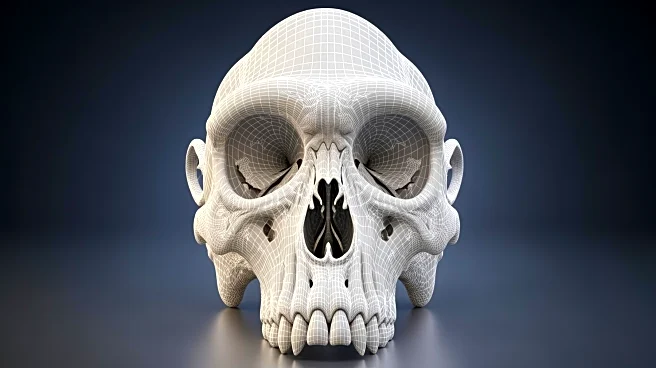
Researchers from the French National Centre for Scientific Research (CNRS), along with British and South African colleagues, have successfully completed the first 3D reconstruction of the face of 'Little Foot', the most complete Australopithecus fossil
discovered to date. The fossil, which was buried in sediments that caused fractures and deformations, has been digitally reconstructed to provide a clearer understanding of its anatomical features. This reconstruction was achieved using advanced digitization techniques at the Diamond Light Source synchrotron in the UK, followed by virtual isolation and realignment of bone fragments using supercomputers. The study, published in Comptes Rendus Palevol, reveals that 'Little Foot's' facial morphology is more similar to Australopithecus specimens from eastern Africa than those from southern Africa, raising questions about the evolutionary relationships and processes among these populations.
Why It's Important?
The successful reconstruction of 'Little Foot's' face is a significant milestone in paleoanthropology, providing new insights into the evolutionary history of hominins. By comparing the facial morphology of 'Little Foot' with other Australopithecus specimens and extant great apes, researchers can better understand the selective pressures that shaped the evolution of early human ancestors. This study not only enhances our knowledge of hominin diversity but also contributes to the broader understanding of human evolution. The availability of the 3D model to the international scientific community allows for further research and analysis, potentially leading to new discoveries about the adaptations and environmental interactions of early hominins.
What's Next?
The 3D reconstruction of 'Little Foot' is now publicly available, enabling researchers worldwide to conduct further studies on the fossil. Future research may focus on other areas of the skull, such as the braincase, to gain additional insights into the cognitive and sensory capabilities of Australopithecus. The findings could also prompt a reevaluation of the evolutionary timeline and relationships between different hominin species. As more fossils are discovered and analyzed, the scientific community can continue to refine the understanding of human ancestry and the factors that influenced the development of modern humans.