
What's Happening?
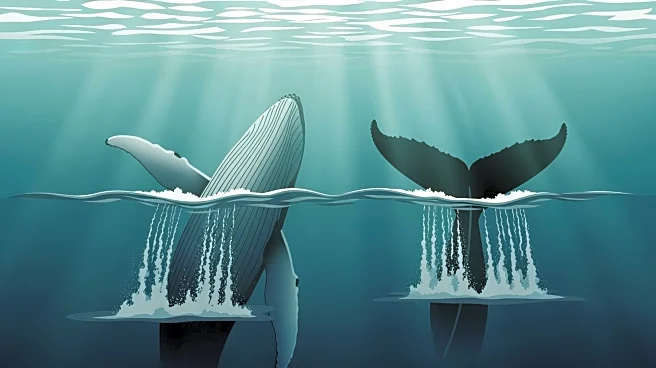
Humpback whales in the fjords of western Canada have adopted a cooperative hunting technique known as bubble-net feeding. This behavior involves whales blowing bubbles to corral fish and then surging upwards
to consume them. The technique, which has been documented among humpbacks in Alaskan waters for decades, has recently been observed in the northeastern Pacific population off Canada. Researchers, led by Éadin O’Mahony at the University of St Andrews, analyzed data from 2004 to 2023, focusing on 526 whales in the Kitimat Fjord System. They found that 254 individuals performed bubble-net feeding at least once, with 90% of these events occurring cooperatively. The behavior's spread coincided with a major marine heatwave in 2014 that reduced prey availability, suggesting that social learning and adaptation are crucial for the whales' survival.
Why It's Important?
The spread of bubble-net feeding among humpback whales highlights the importance of cultural knowledge in animal survival. As prey availability decreases due to environmental changes like marine heatwaves, the ability to adapt feeding strategies becomes vital. This behavior's transmission through social networks underscores the role of social learning in wildlife resilience. Understanding such cultural behaviors can inform conservation efforts, emphasizing the need to protect not just the animals but also the social structures that support their survival. The study suggests that preserving these social behaviors is as crucial as maintaining population numbers, offering insights into how animal cultures can adapt to changing environments.
What's Next?
Future research may focus on further understanding the mechanisms of social learning among humpback whales and how these behaviors can be supported through conservation efforts. As environmental changes continue to impact marine ecosystems, monitoring the spread and adaptation of such feeding techniques could provide valuable data for protecting marine life. Conservationists might explore strategies to preserve the social networks that facilitate these behaviors, ensuring that humpback whales can continue to adapt to their changing habitats.
Beyond the Headlines
The study of bubble-net feeding among humpback whales offers broader insights into the role of culture in animal populations. It challenges the notion that complex behaviors are unique to humans, showing that animals also possess the ability to learn and adapt socially. This understanding could shift conservation strategies to focus more on preserving animal cultures and social structures, rather than solely on population numbers. Additionally, it raises ethical considerations about human impacts on marine environments and the responsibility to mitigate these effects to support wildlife resilience.