







What's Happening?
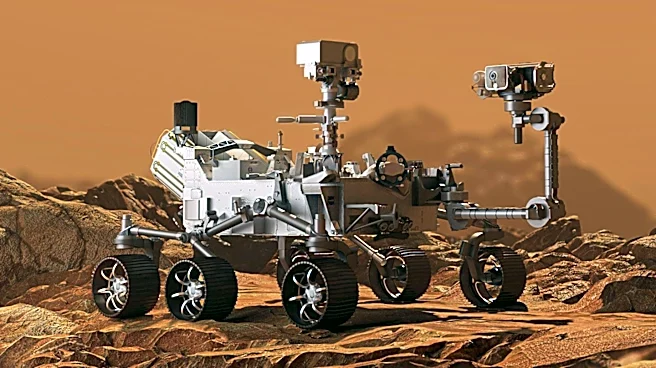
NASA's Curiosity rover has photographed a mysterious honeycomb-like pattern on the Martian surface, adding to the planet's geological mysteries. This discovery was made during the rover's exploration inside Gale Crater, where it captured images of polygonal
structures resembling a honeycomb. Scientists are puzzled by the formation's origin, as similar patterns on Earth are typically formed by processes like drying and cracking mud or freezing and thawing cycles. The rover has been exploring Mars since 2012, studying its rock layers and mineral deposits to understand the planet's past environmental conditions. The honeycomb pattern is the latest in a series of discoveries that challenge scientists' understanding of Mars.
Why It's Important?
The discovery of the honeycomb pattern on Mars is significant as it may provide insights into the planet's geological history and environmental conditions. Understanding these formations could help scientists determine whether Mars once had conditions suitable for microbial life. The ongoing exploration by the Curiosity rover continues to reveal new aspects of Mars, contributing to the broader goal of understanding the planet's potential for past habitability. This finding also underscores the importance of continued exploration and study of Mars to uncover its secrets and assess its potential for future human exploration.
What's Next?
Scientists will continue to analyze the images and geological data returned by the Curiosity rover to determine the formation process of the honeycomb pattern. Further studies may reveal whether the unusual polygons and nearby dark rocks are connected or resulted from separate geological events. As the rover continues its mission, it will cross into new areas with different geological features, potentially leading to more discoveries. The ongoing research aims to deepen our understanding of Mars' geological history and assess its potential for supporting life.