




What's Happening?
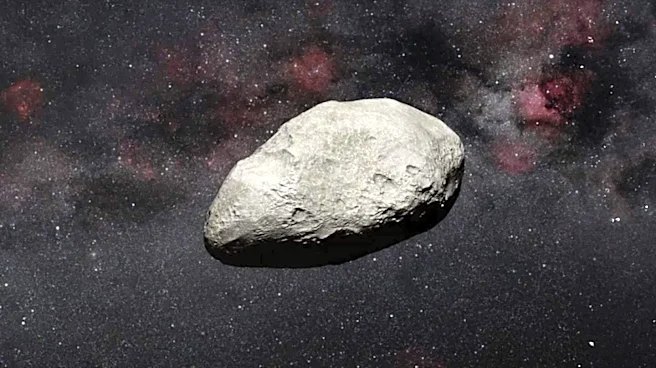
Astronomers have discovered that the asteroid 44 Nysa, first identified in 1857, has a peculiar three-lobed shape and possibly its own tiny moon. This revelation was made possible through advanced observational techniques using the Large Binocular Telescope
in Arizona and the Very Large Telescope in Chile. The asteroid, which is an E-type rich in enstatite, is located in the main asteroid belt between Mars and Jupiter. It is one of the brightest and largest E-type asteroids known, with an average diameter of about 75 kilometers. The three-dimensional model created by researchers shows that 44 Nysa has three distinct lobes connected by thin 'necks'. Additionally, a small moon, approximately one kilometer in diameter, was observed orbiting the asteroid.
Why It's Important?
The discovery of 44 Nysa's unique shape and its moon provides valuable insights into the formation and evolution of asteroids. Understanding the structure and composition of such celestial bodies can inform theories about the early solar system and the processes that shaped it. The presence of a moon offers an opportunity to study the gravitational interactions and internal structure of the asteroid, which could reveal more about its origins. This research contributes to the broader field of planetary science and aids in the development of models predicting asteroid behavior, which is crucial for assessing potential asteroid impact threats to Earth.