




What's Happening?
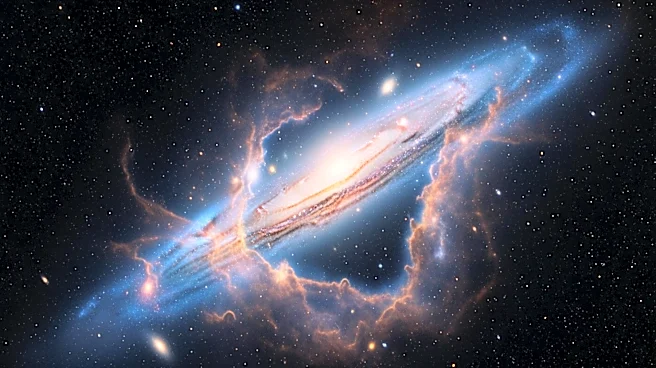
Astronomers have discovered a stellar bar in the GN20 galaxy, which existed 1.5 billion years after the Big Bang. This finding contradicts established theories that suggest such structures take billions of years to form. The GN20 galaxy, observed using
the James Webb Space Telescope, revealed a bar seven kiloparsecs long, challenging the notion that early galaxies' gas-rich environments would suppress bar formation. The presence of highly turbulent gas in the galaxy's inner disk is believed to have facilitated the bar's formation, offering new insights into early galaxy dynamics.
Why It's Important?
The discovery of a stellar bar in GN20 provides critical insights into the early universe's galaxy formation processes. It challenges existing models that predict slow bar formation due to gas-rich conditions in early galaxies. Understanding the dynamics of such early structures can shed light on the evolution of galaxies, including the Milky Way. This research may also explain the high star formation rates in early galaxies and the eventual cessation of star formation, contributing to our understanding of the universe's large-scale structure.
What's Next?
Further studies using advanced telescopes like the James Webb Space Telescope will continue to explore early galaxy structures, potentially leading to revisions of current galaxy formation models. Observations of other early galaxies may reveal similar structures, providing a broader understanding of the conditions that lead to bar formation. This research could also inform models of galaxy evolution, helping to explain the diversity of galaxy shapes and structures observed in the universe today.