
What's Happening?
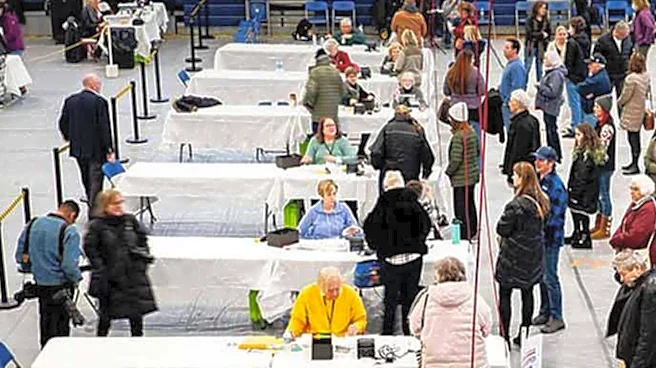
Laramie County experienced a significant primary election turnout in 2026, with every registered voter receiving a ballot for the first time in recent memory. County Clerk Debra Lee noted that this initiative
allowed minor-party and unaffiliated voters, as well as those who typically only participate in general elections, to cast their votes. The voter registration in Laramie County increased by approximately 26% since 2024, reaching a total of 43,757 registered voters, and 23,325 ballots were cast. Republicans accounted for 82% of the ballots, which is the smallest Republican share among Wyoming's three largest counties. Democrats, however, recorded their highest primary turnout since 2020, with 3,000 votes. Lee attributed the increased participation to nonpartisan Cheyenne city council races and a series of county tax propositions, all of which were open to every voter regardless of party affiliation. Additionally, organizations like the League of Women Voters actively promoted participation in the primary elections, contributing to the higher engagement. The method of voting also shifted, with advance voting slightly surpassing Election Day turnout, and nearly 43% of voters utilizing drop boxes for their absentee ballots.
Why It's Important?
This historic primary election turnout in Laramie County highlights a potential shift in voter engagement strategies and their impact on democratic processes. By sending ballots to all registered voters, the county broadened participation beyond traditional party lines, allowing minor-party and unaffiliated voters to influence local and state races. This is particularly significant in Wyoming, where the dominant party's primary often determines most state and local outcomes long before the general election. National research from the Unite America Institute indicates that about 90% of U.S. House seats are decided in low-turnout party primaries, often excluding independent voters from the decisive vote. Laramie County's approach could serve as a model for increasing inclusivity and ensuring a more representative outcome in primary elections. The increased use of advance voting and drop boxes also reflects evolving voter preferences for convenience and accessibility, which could influence future election administration practices nationwide. The successful passage of 13 out of 14 Sixth Penny tax propositions by Laramie County voters further demonstrates the direct impact of this increased participation on local policy and funding decisions.
What's Next?
The success of Laramie County's initiative to send ballots to all registered voters may prompt other counties or states to consider similar strategies to boost primary election participation. Election officials and advocacy groups will likely analyze the data from Laramie County to assess the long-term effects on voter demographics, party influence, and the outcomes of local and state races. The increased engagement of minor-party and unaffiliated voters could lead to a re-evaluation of primary election rules and structures in other regions, potentially fostering more competitive and representative political landscapes. Furthermore, the shift towards advance voting and the widespread use of drop boxes could become more entrenched practices, influencing future election infrastructure and resource allocation. Political parties will also need to adapt their outreach strategies to engage this broader base of primary voters, potentially leading to more diverse candidate pools and policy platforms. The continued monitoring of voter turnout and election results in subsequent cycles will be crucial to understanding the sustained impact of these changes.
Beyond the Headlines
The Laramie County primary election's high turnout and inclusive ballot distribution raise fundamental questions about the nature of democratic participation and the role of primary elections in the U.S. political system. The traditional model, where primaries are often low-turnout events dominated by partisan voters, has been criticized for effectively disenfranchising a significant portion of the electorate and pre-determining general election outcomes. Laramie County's experiment suggests that proactive measures to expand ballot access can significantly alter this dynamic, potentially leading to more moderate candidates and policies that better reflect the broader public's interests. This approach could also mitigate the influence of extreme factions within dominant parties by empowering a more diverse set of voters. Ethically, it underscores the principle that every registered voter should have an accessible pathway to participate in all stages of the electoral process. Culturally, it challenges the perception that primary elections are solely for the most engaged party loyalists, promoting a more inclusive vision of civic duty. The long-term implications could include a re-energized electorate and a more responsive political system, fostering greater trust in democratic institutions.