






What's Happening?
A newly discovered ichthyosaur fossil from the genus Temnodontosaurus has provided researchers with insights into the ecology of the Jurassic Sea. Found in the Mistelgau clay pit near Bayreuth, Germany, the fossil is notable for its survival story, as it shows
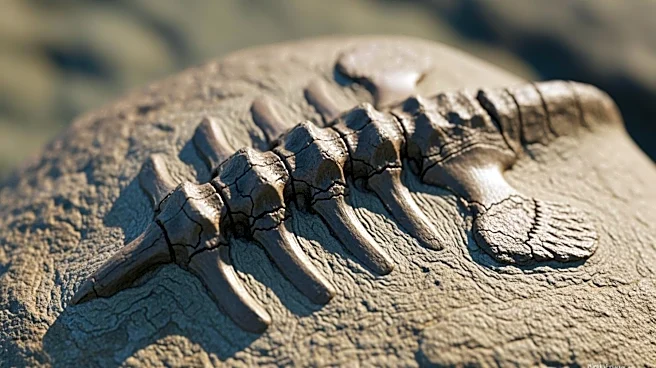
evidence of the reptile adapting to significant injuries. The ichthyosaur, which lived over 180 million years ago, had injuries to its pectoral girdle and jaw that likely altered its hunting and feeding behavior. Researchers reconstructed the animal's life from the fossil, which included parts of the skull, jaws, shoulder girdle, forefins, spine, and over 100 teeth. The study, published in the journal Zitteliana, highlights the reptile's resilience and adaptation, as it survived with these injuries by changing its feeding strategy, evidenced by the wear on its teeth and the presence of gastroliths in its abdomen.
Why It's Important?
This discovery is significant as it sheds light on the adaptability and resilience of ancient marine predators. Understanding how these creatures adapted to injuries provides valuable insights into the ecological dynamics of ancient oceans. The findings contribute to the broader understanding of how top predators responded to environmental stressors and injuries, which can inform current studies on marine ecosystems and their evolution. Additionally, the discovery underscores the importance of fossil-rich sites like Mistelgau for paleontological research, offering a window into the past that can help scientists understand long-term ecological changes.