
What's Happening?
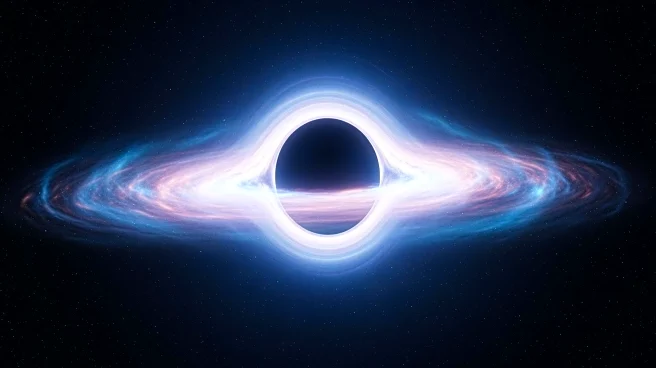
A new study proposes that young supermassive black holes in the early universe may have grown within 'cocoons' of dense gas. This theory emerged from observations made by the James Webb Space Telescope,
which identified several 'Little Red Dots'—objects too bright to be typical galaxies and too red to be simple star clusters. These findings suggest that these black holes, initially thought to be overmassive, are actually in a growth phase surrounded by high-density gas. This cocoon phase could explain the unexpected brightness and mass of these early universe black holes.
Why It's Important?
The study provides a potential solution to the 'overmassive black hole problem,' where observed black holes appeared too massive for their host galaxies. Understanding the growth mechanisms of supermassive black holes is crucial for comprehending galaxy formation and evolution. The cocoon phase theory offers a new perspective on how black holes and galaxies co-evolve, challenging existing models and potentially leading to revised theories about the early universe. This research highlights the importance of advanced telescopes like the James Webb Space Telescope in uncovering the mysteries of cosmic history.
What's Next?
Further research will focus on validating the cocoon phase theory through additional observations and simulations. Scientists aim to explore the implications of this growth phase for the broader understanding of black hole and galaxy evolution. Continued advancements in observational technology and theoretical modeling will be essential in unraveling the complexities of the early universe and the role of supermassive black holes within it.