






What's Happening?
Scientists from Curtin University at the International Centre for Radio Astronomy Research (ICRAR) have identified the source of mysterious radio pulses emanating every 8 minutes from a specific region of the sky. Published in the journal Nature Astronomy,
the source has been determined to be the close binary system GPM J071507−114153. This system consists of a Sun-like yellow star and a white dwarf, orbiting each other at high speed. These radio emissions are classified as long-period transients, a phenomenon where the pulsation period is measured in minutes. While not entirely unique, this particular system is notable because its white dwarf's companion is a yellow star, unlike other known long-period transients where the companion is typically a red dwarf. The yellow star in GPM J071507−114153 exhibits flares similar to those observed on the Sun, and observations suggest the presence of extremely tall plasma loops, or solar prominences. The team at ICRAR first discovered a long-period transient in 2021, and since then, about a dozen similar systems have been found, with GPM J071507−114153 providing the clearest insights into their nature.
Why It's Important?
The identification of GPM J071507−114153 as the source of these 8-minute radio pulses is significant for astrophysics and our understanding of binary star systems. This discovery provides a clearer picture of long-period transients, a class of celestial objects that are not yet fully understood. The unique characteristic of this system, featuring a yellow star as the white dwarf's companion, offers a new data point that could refine existing models of stellar evolution and interaction. Understanding these systems can shed light on the processes of matter flow between stars and how such interactions generate electromagnetic radiation. For the scientific community, this research contributes to the broader effort to map and comprehend the diverse phenomena in our universe, potentially leading to new theories about stellar dynamics and the conditions under which such powerful radio signals are produced. The study of these rare systems helps astronomers piece together the complex puzzle of cosmic events and their underlying physics.
What's Next?
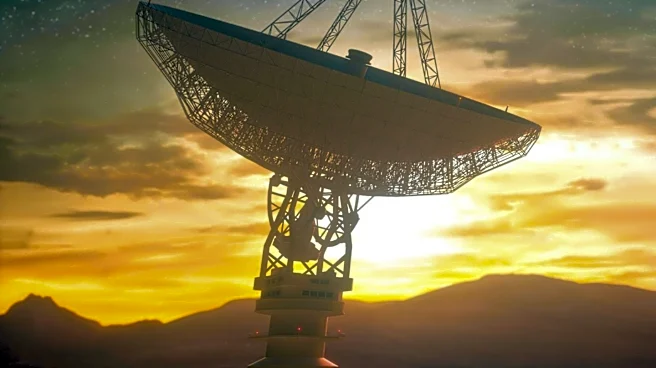
Astronomers will likely continue to observe GPM J071507−114153 and other long-period transients to further unravel their exact nature. Future research will focus on definitively determining the mechanisms behind the flares and the interaction between the white dwarf and the yellow star. Scientists will aim to understand how matter flows towards the more massive component and how this interaction leads to the emission of electromagnetic radiation. The data from this system, being the clearest example found so far, will be crucial for developing more accurate theoretical models for long-period transients. This could involve using advanced radio telescopes and other observational instruments to gather more detailed information about the system's orbital dynamics, magnetic fields, and plasma behavior. The insights gained could also inform the search for other similar systems, potentially expanding the known population of these rare celestial objects and deepening our understanding of stellar astrophysics.
Beyond the Headlines
The study of systems like GPM J071507−114153 has broader implications for our understanding of extreme astrophysical environments. The rapid orbital period of just 8 minutes between a white dwarf and a Sun-like star suggests incredibly strong gravitational forces and intense stellar interactions. This research pushes the boundaries of our knowledge about how stars behave in close proximity, potentially revealing new physics that are not observable in more common stellar configurations. The presence of solar prominence-like plasma loops on the yellow star, influenced by the white dwarf, highlights the dynamic and often violent nature of binary systems. Such discoveries contribute to the ongoing narrative of cosmic evolution, illustrating the diverse and sometimes unexpected ways in which matter and energy interact across vast distances. It also underscores the power of radio astronomy in detecting and characterizing phenomena that are invisible to optical telescopes, opening new windows into the universe's hidden processes.