



What's Happening?
NASA's OSIRIS-REx mission, which surveyed the asteroid Bennu from 2018 to 2021, has provided new insights into the asteroid's surface properties. The mission returned 121.6 grams of Bennu's surface material to Earth, allowing scientists to study its composition
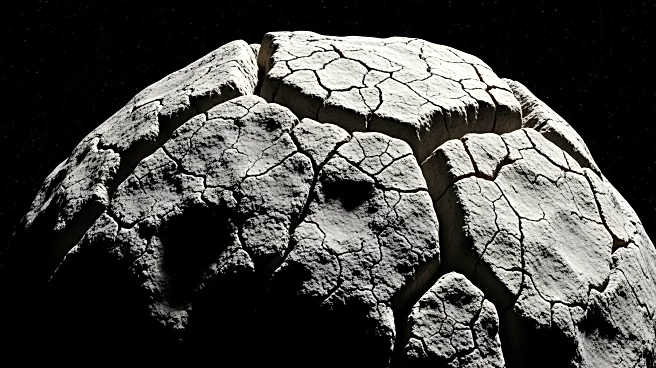
in detail. Recent analyses have revealed that Bennu has a low thermal inertia, primarily driven by the presence of cracks in the returned samples. These cracks affect the thermal properties of the asteroid, influencing how it absorbs and emits heat. The findings are based on thermal diffusivity measurements conducted on various particles from the samples, which were categorized into different types based on their morphology and thermal characteristics.
Why It's Important?
Understanding the thermal properties of asteroids like Bennu is crucial for several reasons. Low thermal inertia can affect an asteroid's orbit over time due to the Yarkovsky effect, where uneven heating causes a small but significant force that can alter its trajectory. This knowledge is vital for predicting the future paths of asteroids and assessing potential collision risks with Earth. Additionally, studying Bennu's surface composition and structure provides insights into the early solar system's formation and the processes that shaped it. The presence of cracks and their impact on thermal properties also offer valuable information for future asteroid exploration missions, particularly those involving landing or sample collection.
What's Next?
The data from Bennu will continue to be analyzed to further understand its composition and the implications of its thermal properties. Future missions may focus on exploring other asteroids with similar characteristics to compare findings and refine models of asteroid behavior. The insights gained from Bennu could also inform the design of spacecraft and instruments for upcoming missions, ensuring they are equipped to handle the unique challenges posed by low thermal inertia surfaces. Additionally, ongoing research may explore the potential for mining asteroids for resources, with Bennu serving as a case study for the feasibility and challenges of such endeavors.
Beyond the Headlines
The study of Bennu's thermal properties highlights the importance of interdisciplinary research in space exploration. Combining geology, physics, and engineering, scientists can develop a comprehensive understanding of asteroids and their potential impact on Earth. This research also underscores the need for international collaboration in space missions, as the knowledge gained benefits the global scientific community and contributes to planetary defense strategies. Furthermore, the exploration of asteroids like Bennu raises ethical considerations regarding the exploitation of extraterrestrial resources and the preservation of these celestial bodies for future generations.