









What's Happening?
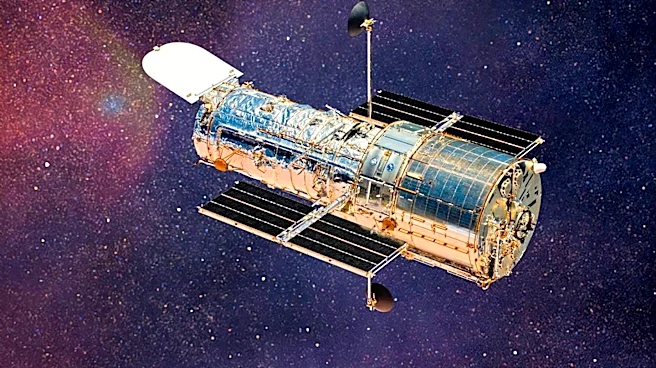
A machine-learning system named AnomalyMatch has processed nearly 100 million image cutouts from the Hubble Legacy Archive, identifying 1,339 unusual cosmic sources. This effort, led by David O’Ryan and Pablo Gómez of the European Space Agency, resulted
in a catalogue where 811 of these sources had no prior reference in scientific literature. The AI system did not autonomously declare discoveries but ranked the images for astronomers to review. The findings include rare versions of known processes such as galaxy mergers and gravitational lenses. The study emphasizes that these anomalies are not necessarily new phenomena but rather objects with unique visible shapes within the dataset.
Why It's Important?
The use of AI in analyzing vast astronomical datasets represents a significant advancement in space research. By identifying rare cosmic phenomena, this method allows astronomers to focus on the most promising candidates for further study, potentially leading to new insights into galaxy formation and evolution. The ability to efficiently process large volumes of data could accelerate discoveries in astronomy, providing a deeper understanding of the universe. This approach also highlights the growing role of AI in scientific research, where it can assist in managing and interpreting complex datasets.
What's Next?
Future applications of this AI technology could extend to upcoming astronomical surveys, such as those conducted by the Vera C. Rubin Observatory and the Nancy Grace Roman Space Telescope. These projects will generate even larger datasets, and AI systems like AnomalyMatch could be crucial in identifying significant anomalies quickly. The continued development of AI in this field may lead to more automated processes in data analysis, allowing researchers to allocate their attention to the most intriguing findings.
Beyond the Headlines
The integration of AI in astronomy raises questions about the balance between automated systems and human expertise. While AI can efficiently process data, the interpretation and validation of findings still rely heavily on human judgment. This collaboration between technology and human insight is essential for advancing scientific knowledge. Additionally, the ethical implications of AI in research, such as data privacy and algorithmic bias, must be considered as these technologies become more prevalent.