



What's Happening?
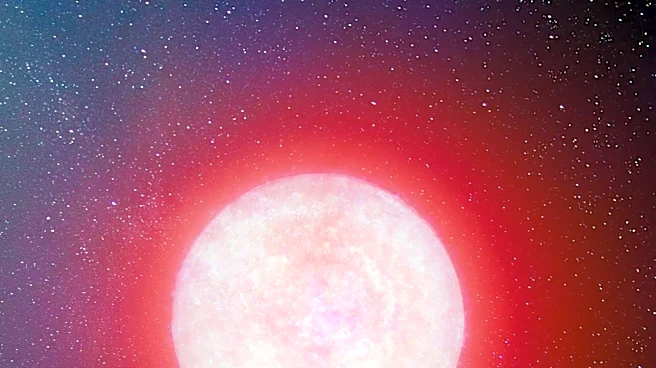
Astronomers have observed the birth of a magnetar for the first time, confirming a theory that these highly magnetic neutron stars can power some of the brightest stellar explosions, known as superluminous supernovae. This discovery, published in the journal
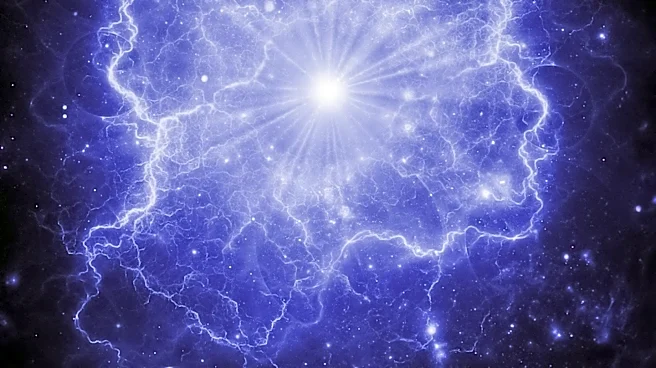
Nature, supports a theory proposed 16 years ago by UC Berkeley physicist Dan Kasen. The research highlights a unique 'chirp' in the light of certain exploding stars, explained by Einstein's theory of general relativity. The supernova, SN 2024afav, was monitored by the Las Cumbres Observatory, revealing unusual light fluctuations indicative of a magnetar's formation. This finding provides definitive evidence that magnetars can form during superluminous supernovae, a hypothesis long suspected but not directly observed until now.
Why It's Important?
This breakthrough is significant as it provides a clearer understanding of the mechanisms behind superluminous supernovae, which are among the most powerful explosions in the universe. The confirmation of magnetars as a power source for these explosions could reshape astrophysical models and theories about stellar evolution and death. It also demonstrates the application of general relativity in explaining cosmic phenomena, reinforcing its role as a fundamental theory in physics. The discovery could lead to further insights into the life cycles of massive stars and the conditions that lead to the formation of neutron stars and black holes, impacting our understanding of the universe's structure and evolution.
What's Next?
The discovery opens new avenues for research into superluminous supernovae and magnetars. Astronomers anticipate finding more 'chirping' supernovae with the upcoming surveys by the Vera C. Rubin Observatory, which will provide unprecedented data on the night sky. This could lead to a better understanding of the frequency and conditions under which magnetars form. Additionally, the study suggests that not all superluminous supernovae are powered by magnetars, indicating that other mechanisms, such as interactions with circumstellar material or black hole formation, may also play a role. Future research will aim to distinguish between these scenarios and refine models of stellar explosions.
Beyond the Headlines
The observation of a magnetar's birth also highlights the intricate interplay between magnetic fields, rotation, and relativistic effects in astrophysical phenomena. The use of general relativity to explain the 'chirp' in the supernova's light curve underscores the theory's relevance beyond traditional contexts like black holes and gravitational waves. This discovery may prompt a reevaluation of other cosmic events where similar relativistic effects could be at play. Furthermore, it emphasizes the importance of multi-wavelength observations and international collaboration in advancing our understanding of the universe.