







What's Happening?
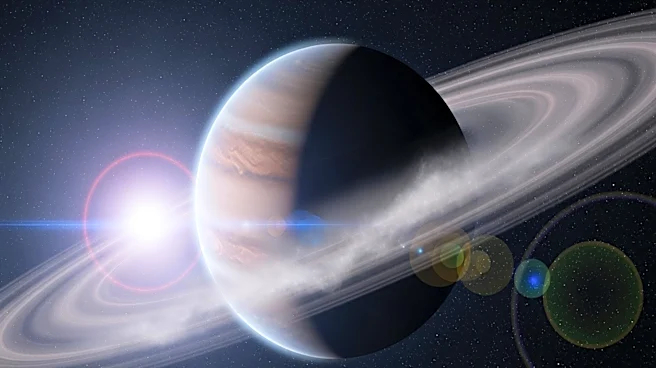
Astronomers using NASA's James Webb Space Telescope (JWST) have conducted a detailed study of the atmosphere of a rare giant planet, TOI-199b, which has temperatures similar to those on Earth. This Saturn-sized exoplanet, located over 330 light-years
away, contains methane in its atmosphere. The study, led by scientists from Penn State and NASA's Jet Propulsion Laboratory, marks the first time the atmosphere of a temperate giant planet has been examined in such detail. The findings could enhance understanding of planetary formation and evolution, potentially offering insights into Earth's atmosphere.
Why It's Important?
The discovery of methane in TOI-199b's atmosphere confirms theoretical models predicting its presence in temperate gas giants. This research could refine models of planetary atmospheres, aiding in the understanding of how planets form and evolve. The study's success encourages further exploration of similar exoplanets, which could reveal whether TOI-199b is unique or shares characteristics with other temperate giants. Such research is crucial for improving our knowledge of planetary systems, including our own, and could have implications for future space exploration and the search for life beyond Earth.
What's Next?
Future observations of TOI-199b could determine the relative abundance of gases like ammonia and carbon dioxide in its atmosphere, providing a more comprehensive understanding of its composition. This could lead to improved models of planetary atmospheres and inform the study of other temperate gas giants. The research team plans to dedicate more resources to studying similar planets, which could reveal common traits among temperate giants and enhance our understanding of planetary systems.