
What's Happening?
Researchers at Michigan Technological University are developing a self-refueling power supply for underwater sensors as part of the Defense Advanced Research Projects Agency (DARPA) BioLogical Undersea
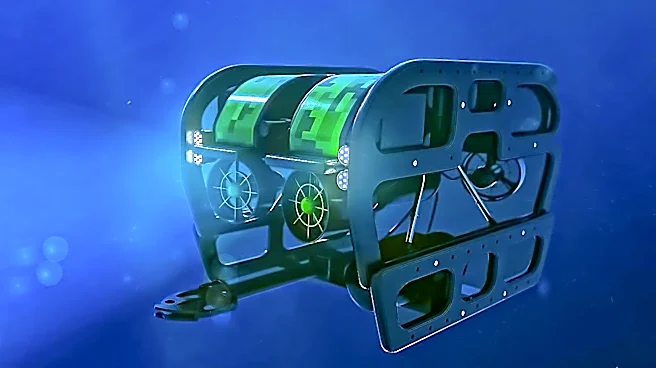
Energy (BLUE) program. This innovative system converts dissolved organic matter and microscopic marine biomass into electrical power using microbial fuel cells (MFCs). The project aims to extend the operational life of ocean sensors, which are crucial for observing ecological conditions, organism migrations, and naval defense acoustics, by eliminating the need for frequent battery replacements. The team, led by Amy Marcarelli, a distinguished professor of biological sciences at Michigan Tech, is addressing the challenges of operating MFCs in the ocean's water column, which has lower organic matter concentration and higher oxygen levels compared to typical MFC environments. The research involves a collaborative effort across four universities and includes 28 researchers, students, and technicians.
Why It's Important?
This development holds significant importance for national security and environmental monitoring. The ability to deploy high-capability, long-endurance ocean-deployed sensor systems that self-refuel without human maintenance would revolutionize marine observation. Currently, the reliance on batteries for underwater sensors necessitates costly and difficult replacement missions. A self-sustaining power source would allow for continuous data collection over extended periods, providing invaluable insights into marine ecosystems and enhancing naval defense capabilities. The project's success would reduce operational costs and risks associated with maintaining underwater sensor networks, making widespread and long-term ocean monitoring more feasible. Furthermore, the interdisciplinary nature of the research, involving biological sciences, engineering, and data science, could lead to broader advancements in sustainable energy solutions and autonomous systems.
What's Next?
The Michigan Tech-led DARPA BLUE team is currently making small adjustments to their system's operations to maximize power output. Following successful short submersion tests in Galveston Bay, the researchers plan to deploy a 10-microbial-fuel-cell system in Chesapeake Bay for a month, starting in mid-May. Data collected from these deployments, along with environmental observations, will be used by data science experts at the Michigan Tech Research Institute to project the system's performance over a year-long deployment. The team is also developing sophisticated statistical models to forecast where and when the necessary organic matter will be available in the ocean. The ultimate goal is to create a robust, deployable system that can be easily integrated by federal government agencies for various marine applications.
Beyond the Headlines
The DARPA BLUE program's focus on microbial fuel cells represents a significant step towards harnessing natural biological processes for technological applications. This approach not only offers a sustainable energy solution but also highlights the potential for bio-inspired engineering to address complex environmental and logistical challenges. The project's emphasis on biosafety, by cultivating and deploying microbes native to the target environments, underscores a responsible approach to integrating biological systems into technology. The development of predictive models for fuel availability also points to a future where environmental data science plays a crucial role in optimizing the deployment and efficiency of autonomous systems. This research could pave the way for a new generation of self-sufficient marine technologies, reducing humanity's footprint on sensitive ocean environments while expanding our capacity for exploration and defense.