







What's Happening?
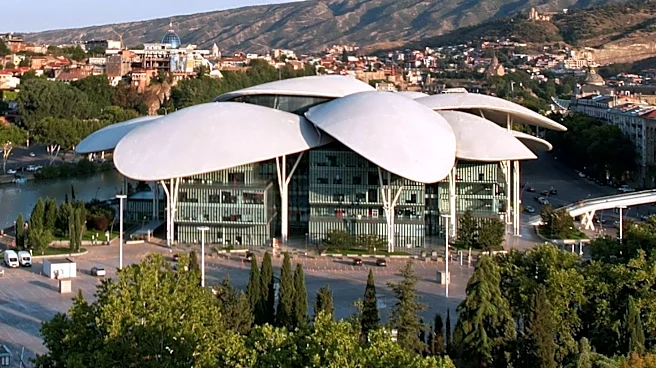
Georgia, situated in the Caucasus region of Eurasia, holds a unique geographical position bordered by Russia, Turkey, Armenia, Azerbaijan, and the Black Sea. This location at the crossroads of Europe and Asia has profoundly influenced its history, politics,
and culture. The country, roughly the size of South Carolina, boasts diverse landscapes from the snow-capped Greater Caucasus Mountains to subtropical Black Sea coastal regions. Historically, Georgia has experienced periods of independence and occupation, notably gaining independence from the Soviet Union in 1918, being re-occupied in 1921, and declaring independence again in 1991. Today, Georgia is a democratic parliamentary republic actively strengthening its international ties and seeking membership in European and Euro-Atlantic structures, participating in organizations like the United Nations and the OSCE.
Why It's Important?
Georgia's strategic location makes it a critical player in regional politics, with various countries and organizations vying for influence in the Caucasus. For the U.S., understanding Georgia's geopolitical significance is crucial for maintaining stability and promoting democratic values in a region that serves as a bridge between continents. Its efforts to integrate with European and Euro-Atlantic structures align with Western interests in fostering democratic governance and market economies. The country's rich cultural heritage, a blend of Eastern European and Asian traditions, also highlights the broader cultural diversity of Eurasia. The ongoing competition for influence in the Caucasus underscores the region's importance for energy transit routes and geopolitical stability, directly impacting international security and economic interests.
What's Next?
Georgia is expected to continue its pursuit of closer ties with European and Euro-Atlantic organizations, aiming to strengthen its economic, cultural, and security partnerships. This trajectory will likely involve further reforms to align with Western standards and increased engagement in international forums. The country's strategic position means it will remain a focal point for regional politics, with ongoing efforts to balance relationships with neighboring powers and international partners. The development of its infrastructure and economic ties will also be critical, as it seeks to leverage its geographical advantage as a transit hub between Europe and Asia.
Beyond the Headlines
Georgia's complex history of independence and occupation reflects the broader historical struggles of nations situated at geopolitical crossroads. Its unique cultural blend, influenced by centuries of interaction between diverse civilizations, offers a rich tapestry of traditions, language, and architecture. The country's commitment to democratic governance in a challenging neighborhood highlights the enduring appeal of democratic ideals. The long-term implications of Georgia's strategic position include its potential to serve as a stable and democratic anchor in the Caucasus, contributing to regional security and economic integration, while also navigating the pressures from competing geopolitical interests. Its cultural significance, exemplified by sites like the Svetitskhoveli Cathedral, underscores the deep historical roots that continue to shape its national identity and international relations.