


What's Happening?
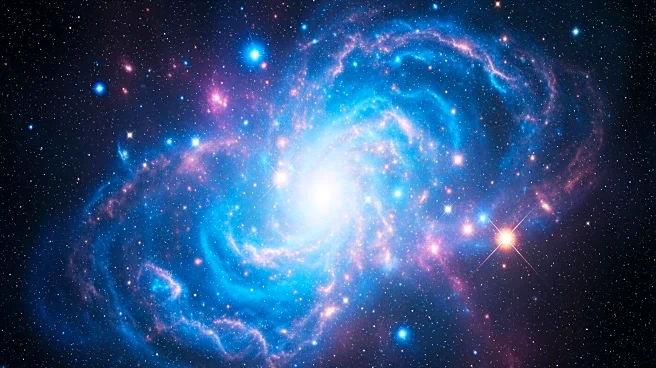
Astronomers using NASA's Hubble Space Telescope have identified a potential 'dark galaxy,' named Candidate Dark Galaxy-2 (CDG-2), which is characterized by its extremely low brightness. This galaxy, located approximately 300 million light-years from Earth,
is believed to be composed of at least 99.9% dark matter, making it one of the most dark matter-heavy galaxies ever discovered. The presence of dark matter is inferred through its gravitational effects on regular matter, as dark matter itself is invisible. CDG-2 is categorized as a 'low surface brightness galaxy,' a type of galaxy that appears faint due to a high ratio of dark matter to normal matter. The discovery was made by observing globular clusters, which are bright groupings of old stars, suggesting the presence of a galaxy despite its faintness. The study, led by Dayi Li from the University of Toronto, highlights the potential of using globular clusters to identify such dark galaxies.
Why It's Important?
The discovery of CDG-2 is significant as it provides insights into the behavior of dark matter, a substance that dominates the universe but remains largely mysterious. Understanding dark galaxies like CDG-2 can offer a clearer view of dark matter's properties, as these galaxies have minimal interference from ordinary matter. This research could advance cosmological theories and simulations that predict the existence of dark galaxies. The findings also suggest a new method for identifying dark galaxies, which could lead to further discoveries and a deeper understanding of the universe's composition. The study emphasizes the importance of dark matter in holding galaxies together and its role in the universe's structure.
What's Next?
Further observations are needed to confirm the dark matter content of CDG-2 and to explore its physical properties. The James Webb Space Telescope could be instrumental in these future studies. Researchers aim to refine the methods used to detect dark galaxies and to expand the search for similar galaxies. This could lead to a better understanding of the distribution and behavior of dark matter in the universe. The study also opens up possibilities for using globular clusters as indicators of dark galaxies, potentially leading to the discovery of more such galaxies.