




What's Happening?
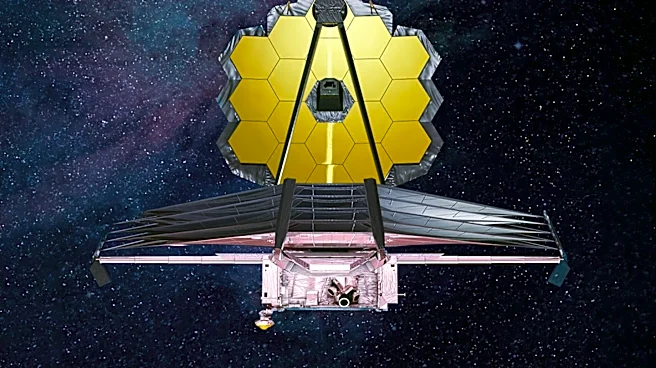
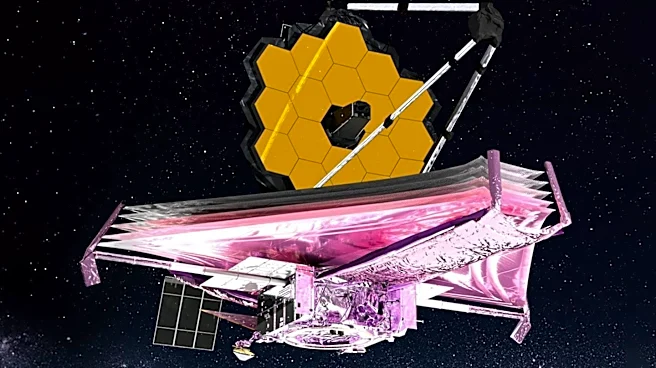
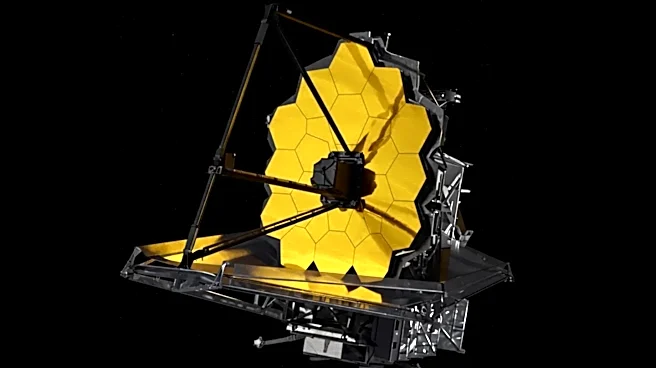
Astronomers using the James Webb Space Telescope (JWST) have proposed a new explanation for the mysterious 'little red dots' (LRDs) observed in the early universe. These compact, bright celestial objects were found to have emerged around 600 million years
after the Big Bang and began disappearing about a billion years later. The new study suggests that LRDs may be formed by previously undiscovered celestial companions, which emit intense ultraviolet (UV) radiation. This radiation causes gas clouds to collapse into dense objects, potentially forming 'black hole stars.' The study, published in The Astrophysical Journal Letters, analyzed 83 LRDs and found that many had UV-bright companions, suggesting a complex formation process involving these companions.
Why It's Important?
This discovery is significant as it provides insights into the formation of supermassive black holes and the evolution of galaxies in the early universe. The proposed mechanism suggests that the UV radiation from the companions prevents gas clouds from fragmenting, leading to the formation of supermassive stars that collapse directly into black holes. This process could explain how ancient supermassive black holes grew so large so quickly. Additionally, the merging of LRDs with their UV companions might have contributed to the formation of massive galaxies observed today. Understanding these processes helps astronomers piece together the history of the universe and the development of its large-scale structures.
What's Next?
Future observations with the JWST and other telescopes will aim to further investigate the relationship between LRDs and their UV companions. Researchers will look to confirm the presence of these companions and explore their role in the formation of supermassive black holes and galaxies. These studies could provide more detailed insights into the early universe's dynamics and the processes that led to the current cosmic landscape. Continued research may also explore whether similar processes occurred in the formation of the Milky Way and other galaxies.