






What's Happening?
In November 1996, Richard Lyons, an employee of the U.S. General Services Administration (GSA), made a significant historical discovery in a dilapidated building at 437 Seventh Street, NW, in Washington, D.C. While inspecting the building slated for demolition
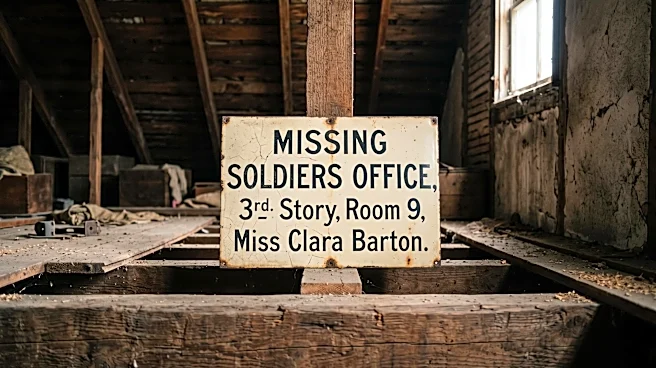
as part of the Penn Quarter neighborhood's rehabilitation, Lyons found a crawlspace on the third floor filled with 19th-century artifacts. Among these items was an enameled sign reading, 'Missing Soldiers Office, 3rd. Story, Room 9, Miss Clara Barton.' This discovery confirmed that the building was the former residence and workplace of Clara Barton, where she operated 'The Office of Correspondence with Friends of the Missing Men of the United States,' later known as the Missing Soldiers Office (MSO). The MSO played a crucial role in determining the fate of nearly 22,000 missing Civil War soldiers. The find led to a long-term project, a public/private partnership between the National Museum of Civil War Medicine and the GSA, culminating in the official opening of the Clara Barton Missing Soldiers Office Museum (CBMSO) on July 28, 2015.
Why It's Important?
The discovery and subsequent preservation of Clara Barton's Missing Soldiers Office are profoundly important for understanding a critical period in U.S. history and the humanitarian efforts that emerged from it. Clara Barton, a pivotal figure in American history, not only provided aid during the Civil War but also established an office dedicated to locating missing soldiers, a precursor to modern humanitarian organizations. The museum preserves a tangible link to her work, offering insights into the challenges faced by families during and after the war. The recovery of over 2,000 artifacts, including correspondence and a rare 'Roll of Missing Men,' provides invaluable primary source material for historians and the public. This project also exemplifies a successful collaboration between a federal agency (GSA) and a non-profit organization, demonstrating how historical preservation can be achieved through dedicated partnerships. The museum now serves as an educational resource, telling the story of Barton's enduring impact on the world.
What's Next?
The Clara Barton Missing Soldiers Office Museum continues to operate, offering visitors a unique glimpse into Civil War-era humanitarian efforts. The museum's ongoing mission involves educating the public about Clara Barton's life and work, the significance of the Missing Soldiers Office, and the broader context of the Civil War. Future initiatives may include further research into the recovered artifacts, educational programs for schools, and public events to raise awareness of Barton's legacy. The success of this public/private partnership could also serve as a model for other historical preservation projects across the nation, encouraging similar collaborations to safeguard and interpret significant historical sites. The museum's continued operation ensures that Barton's contributions to American society and her pioneering role in humanitarian aid remain recognized and celebrated.
Beyond the Headlines
The story of the Clara Barton Missing Soldiers Office Museum extends beyond mere historical preservation; it highlights the enduring power of individual initiative and compassion in times of national crisis. Clara Barton's dedication to identifying missing soldiers not only brought closure to thousands of families but also laid foundational principles for organizations like the American Red Cross. The discovery of her office, hidden for over a century, underscores how historical narratives can be unearthed and brought to light through diligent effort and serendipitous events. It also serves as a reminder of the often-overlooked contributions of women in shaping American history. The museum's existence encourages reflection on the human cost of war and the persistent need for humanitarian aid, making Barton's work as relevant today as it was during the Civil War. The preservation of such sites helps to connect contemporary society with its past, fostering a deeper understanding of national identity and values.