



What's Happening?
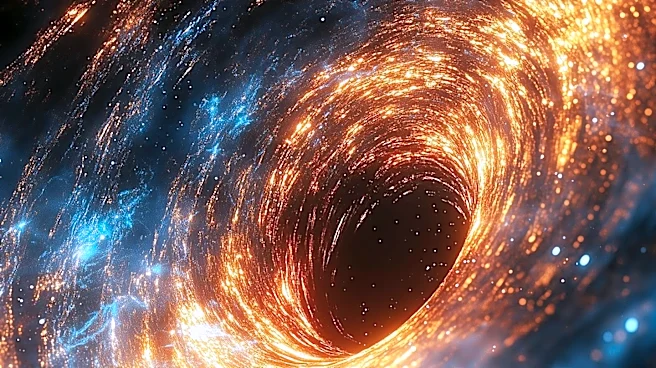
New research suggests that black holes as light as 40 metric tons, roughly the mass of a loaded semi-truck, could exist and grow inside compact stars like neutron stars and white dwarfs, provided dark matter is involved. This challenges Stephen Hawking's
1974 prediction that lighter black holes evaporate quickly through Hawking radiation. The study posits that hypothetical ultraheavy asymmetric dark matter particles can accumulate in a star's core, become self-gravitating, and collapse to form a tiny 'endoparasitic' black hole. Once formed, this black hole's fate is determined by a competition between mass gain from accreting ordinary stellar matter and continued dark matter supply, versus mass loss through Hawking radiation. Under specific conditions, particularly in dark matter-rich environments like the Galactic bulge, a black hole with an initial mass of just 40 metric tons could have a positive growth rate, eventually consuming its host star.
Why It's Important?
This research significantly advances our understanding of black hole physics and the potential role of dark matter in astrophysical phenomena. If confirmed, it would imply that black holes can form and sustain themselves at much smaller masses than previously thought, especially within stellar environments. This could lead to new avenues for detecting dark matter, as the survival of ancient compact stars like millisecond pulsars and white dwarfs could constrain the properties of ultraheavy dark matter particles. Essentially, these stars act as natural dark matter detectors over astronomical timescales, providing indirect evidence for dark matter's existence and characteristics. The findings could also reshape theories about stellar evolution and the ultimate fate of stars, suggesting a novel mechanism for stellar destruction and transformation into black holes.
What's Next?
The immediate next steps involve further theoretical modeling and observational searches for evidence supporting this hypothesis. Scientists will likely refine calculations to account for additional stellar properties such as rotation and magnetic fields, which could modify the critical mass required for growth. Astronomers may also look for observational signatures that could indicate the presence of these endoparasitic black holes or the effects of their growth within compact stars. Furthermore, the implications for dark matter research are significant; if this mechanism is viable, it could guide experiments designed to detect dark matter by providing new constraints on its particle properties. The study also opens the door for re-evaluating existing astronomical data for anomalies that might be explained by such phenomena.
Beyond the Headlines
The concept of tiny black holes growing within stars due to dark matter introduces profound implications for fundamental physics. It blurs the lines between cosmology, particle physics, and astrophysics, suggesting a deeper interconnectedness of the universe's most mysterious components. Ethically, while not directly applicable, the pursuit of such knowledge pushes the boundaries of human understanding of existence and the universe's mechanics. Legally, there are no direct implications, but the scientific community will rigorously scrutinize these findings, potentially leading to new theoretical frameworks and experimental designs. Culturally, such discoveries often capture public imagination, highlighting the ongoing quest to unravel cosmic mysteries and our place within them, potentially inspiring future generations of scientists and fostering a greater appreciation for scientific inquiry.