





What's Happening?
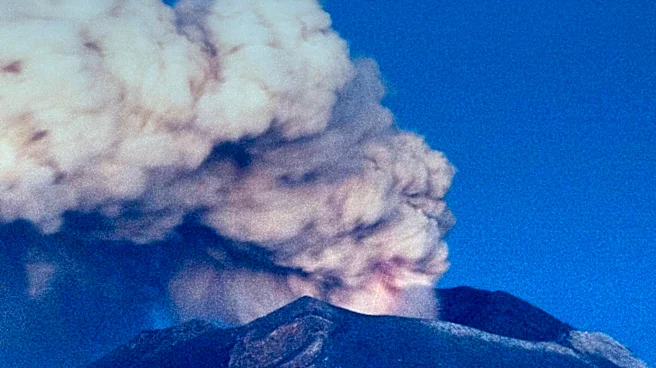
Mount Erebus, a stratovolcano in Antarctica, has been continuously erupting for over 50 years, producing a persistent lava lake. Recent studies have revealed that the volcano emits approximately 80 grams of microscopic gold particles daily, valued at over $10,000.
This phenomenon is attributed to the unique phonolitic lava composition of Erebus, which is rare among Earth's volcanoes. The gold particles are believed to form as volcanic gases cool and condense, potentially transported as a gold-chloride compound. Despite the intriguing presence of gold, mining activities are prohibited under the Environmental Protocol to the Antarctic Treaty, which bans mineral resource activities except for scientific research.
Why It's Important?
The discovery of gold emissions from Mount Erebus highlights the complex interactions between geological processes and valuable mineral formations. While the gold itself is not economically viable to extract due to its dispersion and the legal restrictions, the findings contribute to a deeper understanding of volcanic activity and its potential to transport and deposit minerals. This research can inform future studies on similar volcanic systems and their economic implications. Additionally, the prohibition of mining in Antarctica underscores the importance of preserving the continent's unique environment and prioritizing scientific exploration over commercial exploitation.
What's Next?
Researchers will continue to monitor Mount Erebus using seismometers and satellite technology to study its ongoing activity and the dynamics of its lava lake. The findings from Erebus may provide insights into the behavior of other volcanoes with similar characteristics. As scientific interest in Antarctica grows, the focus will remain on understanding the geological and biological processes at play, while adhering to international agreements that protect the region from commercial exploitation.
Beyond the Headlines
The presence of gold in Erebus's emissions also raises questions about the potential for similar phenomena in other remote volcanic regions. The study of Erebus's unique magma composition and its effects on surrounding ecosystems could offer analogs for extraterrestrial environments, such as those on icy moons with internal heat sources. This research not only enhances our understanding of Earth's geological history but also informs the search for life beyond our planet.