






What's Happening?
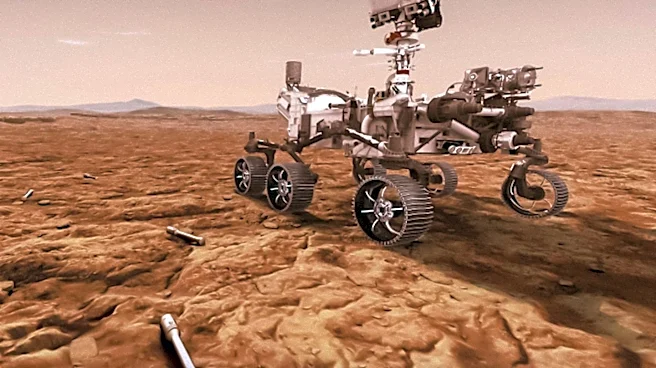
NASA's Perseverance rover, exploring the 'Margin Unit' within Mars' Jezero Crater, has discovered igneous rock formations that reveal a complex history of water interaction on early Mars. Contrary to initial hypotheses based on orbital observations, which
suggested sedimentary rocks and carbonates formed by a lake, the rover found igneous rock. This rock, which forms from magma or volcanic activity, provides a detailed record of its formation. The SuperCam instrument on the rover analyzed over 185 bedrock targets, determining their mineralogy. The findings indicate that these rocks interacted with water on at least three separate occasions, each event altering their chemistry and appearance. This discovery challenges previous assumptions about the geological history of the Jezero Crater, a site believed to have once hosted an ancient Martian lake.
Why It's Important?
This discovery is crucial for understanding the past habitability of Mars and the potential for ancient microbial life. The presence of igneous rocks, rather than expected sedimentary formations, provides a different perspective on the geological processes that shaped Jezero Crater. Igneous rocks are excellent at preserving details about their formation, offering insights into the precise moments they interacted with water. The multiple episodes of water interaction recorded in these rocks suggest a dynamic and evolving aqueous environment on early Mars. The detection of carbonate and silica minerals, which on Earth can indicate the presence of hydrogen-releasing reactions that support microbial life, further fuels the astrobiological investigation. This research, led by Candice Bedford of Purdue University, could reshape scientific understanding of water's role in Jezero Crater and across Mars, influencing future missions and the search for extraterrestrial life.
What's Next?
The Perseverance team will continue to analyze the data collected from the Margin Unit to further unravel the sequence and nature of water interactions, although determining the precise age of these events remains a challenge. Future research will likely focus on understanding how these findings impact the broader understanding of Mars' ancient climate and habitability. The rover's primary objective of astrobiology, including the search for signs of ancient microbial life and the collection of Martian rock and regolith samples for eventual return to Earth, will continue to be guided by these new geological insights. The ongoing mission will aim to connect these localized discoveries to the larger context of Mars' geological and hydrological evolution, potentially leading to a more refined understanding of the planet's past and its potential to harbor life.
Beyond the Headlines
The unexpected discovery of igneous rocks and their intricate water interaction history in Jezero Crater highlights the dynamic and often surprising nature of planetary exploration. It underscores the importance of in-situ measurements by rovers like Perseverance, which can provide ground truth that refines or even overturns conclusions drawn from orbital data. This finding also emphasizes the complexity of geological processes on other planets, suggesting that Martian history may be far more nuanced than previously imagined. The implications extend beyond Mars, informing our approach to studying other celestial bodies and the search for life elsewhere in the universe. The continuous re-evaluation of scientific hypotheses based on new data is a cornerstone of scientific progress, and this discovery serves as a prime example of that iterative process in action.